

Happy National Bacon Day!
I have two super fun friends that live in Minnesota named Lindsay and Jessie.
Jessie happens to loooove bacon and is frequently photographed wearing her bacon costume. So, when I went to visit last summer, I wanted to be aligned with the mission and bought an egg costume to wear at the airport.
We spent the weekend laughing and having tons of fun!
One of the things we did was participate in a OCR event.
OCR stands for Obstacle Course Race, and I’ve lost track of how many Tough Mudder races Jessie & Lindsay have participated in.
It might be more than 100 at this point. They are nuts, in a great way.
The idea is that you have obstacles along a 5k or longer course that you can choose to tackle, help others tackle, or skip entirely with absolutely no shame.
You know what it reminds me of?
An adult playground!
All the obstacles are designed to fit adult -sized people, and you know what else is fun about it?
The team or community element. You help others, and they help you.
It’s additionally just fun to have something to train for, rather than just general fitness and health.
The obstacles add a strength component in a way that ordinary running races don’t offer.
I did a Tough Mudder (race involving mud over a half marathon course with 20ish obstacles) with my brother when he turned 40, and wrote a blog highlighting my top tips if you’re considering heading out to one of these races.
What are your plans for the fall? How are you going to have fun and stay or get fit?
Happy FriYAY!
Here’s to balance, fun with strength, and happiness,
🙂 Laura
We escaped to the Oregon Coast during the 4 days that Portland had temperatures in the 100s.
We just happened to choose a happening surf spot to camp near, and I struck up a conversation with a surfer as he was climbing up the stairs that led to the beach.
“How was it?” I asked.
“Great,” he said. “It was warm (says the guy in a full thick wetsuit with a hood and booties in an ocean I know was 55 degrees F that day) and there was no wind.”
But then he said something that made me smile.
What did he say to me that left me feeling inspired?
Watch the 33 second video above and see if you are similarly encouraged to adopt his philosophy if you don’t already.
Happy Hump day!
Here’s to balance, strength, and happiness!
😊 Laura
Happy Race Your Mouse Day!
Are you a desk jockey, often finding yourself in front of a screen, using your mouse extensively?
That sitting stuff can catch up with you, and it’s easy to start slouching down slowly in your chair.
This happened to my client Austin recently. He had an extended project that required extended sitting at his desk to complete.
Soon after, what he called his “haunch” hurt. That was the lower side quadrant of his low back.
Happily, it was fixed very quickly with what’s called “hip hinging”.
This is where you lean over using your hips as the fulcrum.
Alternatively, if you don’t use your hips, you end up using your back instead.
He does a beautiful job of demonstrating both leaning over using his back, and then using his hips on the right side in the video above.
He says in the video, “it doesn’t hurt when I do it this way!”
Are you a hip hinger?
Here’s to balance, strength, and hip hinging happiness!
🙂 Laura
Happy National Dog Day! (Tomorrow!)
The video above is of my friend Heather’s puppy Luna.
Cuteness overload!
Luna was “helping” me film the other day when I was talking about the benefits of eating protein.
I’m working on my “under recovery” at the moment.
On Wednesday I talked about getting to bed in the same 30 minute window every night.
One of the complaints I had was that if I stop lifting weights my muscles seem to evaporate and my skin starts to get “crepey”.
My dear nutritionist friend Margaret Floyd Barry suggested that I try upping my protein intake to 120grams/day in (3) 40 gram meals.
She said to avoid “protein dribble” with 10g here and 10g there.
She also said there is approximately a 40-50g upper limit at any one time after I ate 58g in one meal.
Can’t absorb that much.
Is this for you?
**Caveat: I have worked on my protein digestion with her previously, so I’m confident that my digestive process is relatively intact. If you’re not sure about that, find a functional nutritionist or work with your naturopath or homeopath to fire that up if they know how to help.
The latest research says that if you’re a 50ish + woman you need to lift heavy twice a week and eat lots of protein.
Therefore, this is not just about me and my quest to conquer my “under recovery”!
Luna helps while I explain another benefit of eating tons of protein and I laugh most of the 35 second video above.
Laughter is contagious so if you need a laugh on this FriYAY…
Here’s to balance, strength, and happiness,
🙂 Laura (& baby puppy Luna!)
Happy National Senior Citizen’s Day!
Here’s the question: Are you ever too old to lift weights?
Nope.
Not ever.
Why would you?
Muscles are the engines of the body and are the best anti-aging strategy you have.
The brain does not recognize the passage of time; instead it only knows if you are using your muscles or not.
If using muscles: All Systems GO!
If not using muscles: There’s the invitation to slowly shut down all the systems.
Just ask Joan MacDonald.
She’s 75 and lifts weights with her daughter 5 days a week.
Her story is so inspirational, which her daughter documented, that she now has 1.8 million followers on Instagram.
You read that right.
1,800,000 followers.
Watch the 2.5 minute story above when she and her daughter were interviewed by Good Morning America last year.
Then, go get some weights!
I do it twice a week myself and am happy to help you get started if you don’t know where to start.
Tap into the best anti aging strategy you have!
Here’s to balance, STRENGTH, and happiness!!
🙂 Laura
Happy Ride the Wind Day!
Portland had a heat wave last week and we headed to the beach to work remotely. Guess what we got to do while we were there?
Fly a kite!
It was super fun, whimsical, and brought back so many memories of trying to get kites in my childhood aloft.
Usually without much success. 🙂
While I was flying my kite, I discussed an interesting concept that my dear nutritionist friend Margaret Floyd Barry proposed to me:
Was I overtraining or was I …and this was a new concept…
u n d e r r e c o v e r i n g?
Hmn.
So interesting.
What exactly did she mean?
Quite a few things, actually.
Sleeping. Eating. Supplements. Training program.
Did this mean that I could play on as many soccer teams as I want, workout twice a day, run on my track team, and train for the New York marathon all at once?
I certainly hope so, because that’s what I want to do, but currently it feels like it falls a bit into the overtraining category right now.
I realize most people don’t have the same goals, but on the other hand, I want you to do as much as YOU want to without any limits.
One suggestion: get into bed in the same half hour period of time every night. That apparently has a huge impact on sleep quality.
(That is going to be a tough one for me, especially when Womens World Cup Finals are at 3am!)
Let’s talk about more of her suggestions this week!
Here’s to balance, strength, and recovery happiness,
🙂 Laura
Do you suffer from, or know someone who suffers from:
->Scoliosis ->Chronic insomnia ->High blood pressure ->Sleep apnea ->Snoring ->Elevated heart rate ->ADHD ->Bed-wetting ->Cancer ->Low mental clarity ->Depression ->Dehydration ->Getting up to pee in the night ->Tight shoulders ->Poor core muscles
Or poor athletic performance….Just to name a few things.
What a big list! What could possibly impact all of these maladies?
What if I could give you a simple tool that should impact any or all of those diseases?
Would you be willing to try it?
By the way….Here’s another great attribute to this ‘magic pill’…
It’s free and you can start immediately.
Immediately.
What, oh what, is this magic pill?
Believe it or not, this magic pill isn’t a pill at all. (You know I’m not crazy about pills!)
It’s actually …drumroll… how you breathe.
Have you ever paid attention to exactly how you breathe?
What I’d like to know is HOW. How do you breathe?
Are you a mouth breather, or are you a nose breather?
I’ve just finished James Nestor’s book Breath. He spends the entirety of the book making the case for nose breathing, summarizing a decade of his personal research into the centuries of fellow ‘pulmonauts’ who have conducted experiments on themselves and others in an effort to impact all of the diseases listed above.

In 2013, for instance, a research group in Japan compared oxygenation to the prefrontal cortex (the part of the brain associated with ADHD) in mouth breathers vs. nose breathers. The mouth breathers “delivered a disturbance of the oxygen getting to the prefrontal cortex. Nasal breathers had no such effects.” (P. 31)
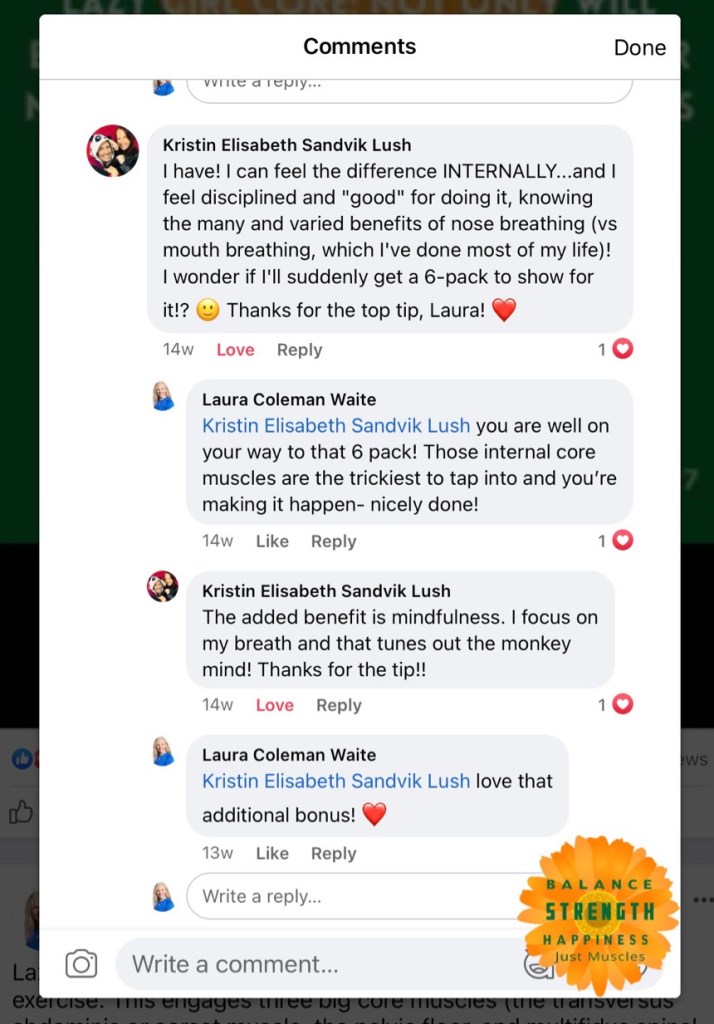
A friend of mine named Kristin noticed the difference in her ability to focus right away. She posted to Facebook that “her monkey mind was quieted”. Here is what she said:
When the author subjected himself to a ten day mouth breathing experiment run by the Stanford Chief of Rhinology Dr. Jayakar Nayak he found that in the very first 24 hours he had 4 fourfold increase in sleep apnea events. Additionally, his snoring increased by 1300% to 75 minutes/night.
In 10 days his snoring increased by 4,820%.
How about that. I’m no statistician, but that’s pretty impressive.
That wasn’t all… after 10 days of mouth breathing he had 25 sleep apnea ‘events’ where blood oxygen dropped below 90%. Why is this significant? Because “blood can’t carry enough oxygen to support body tissues. If this goes on too long, it can lead to heart failure, depression, memory problems, and early death.” (P. 20)
He wrote about his fear in recognizing that his own body was caving in on itself, and severely impacting his health, vitality, and longevity in a very short period of time…10 days to be exact!
Caving in?
Turns out that “Mouthbreathing changes the physical body and transforms airways, all for the worse. Inhaling through the mouth decreases pressure, which causes the soft tissues in the back of the mouth to become loose and flex inward, creating less space and making breathing more difficult. Mouthbreathing begets mouthbreathing.”

In contrast, nasal breathing “forces air against those flabby tissues at the back of the throat, making airways wider and breathing easier. After awhile, these tissues and muscles get “toned” to stay in this wide and open position. Nasal breathing begets nasal breathing. “ (P. 27)
How might this impact your exercise?
Well, in the 90’s Dr. John Douillard trained elite athletes like the New Jersey Nets, Billie Jean King, and triathletes. He decided to put pro cyclists on stationary bikes with heart rate and breathing rate sensors and slowly increased the resistance while exclusively mouth breathing. “As intensity increased, so did the rate of breathing, which was expected. By the time athletes reached the hardest stage of the test, pedaling out 200 watts of power, they were panting and struggling to catch a breath.” (P. 23)
Now they switched to nose breathing. “As the intensity of exercise increased during this phase, the rate of breathing decreased. At the final 200-watt stage one subject who was mouth breathing at a rate of 47 breaths per minute was nasal breathing at a rate of 14 breaths a minute. He maintained the same heart rate at which he’d started the test, even though the intensity of the exercise has increased tenfold.”

WOW!
How would you like to maintain the same heart rate, regardless of the intensity?
This was Dr. Douillard’s fantastic conclusion:
“Simply training yourself to breathe through your nose, Douillard reported, could cut total exertion in half and offer huge gains in endurance. The athletes felt invigorated while nasal breathing rather than exhausted. They all swore off breathing through their mouths ever again.” (P. 24)
Swore off.
Ever again.
That’s pretty powerful.
Doesn’t matter that they were pro athletes.
Just matters that they were deeply impressed.
Here’s my question: Knowing what you do now about the benefits of nose breathing, why would you ever do anything else?
“But Laura, I have allergies.”
“But Laura, I have a deviated septum.”
“But Laura, I have asthma.”
All the more reason to get started right away! There’s no time to lose!
Don’t let evolutionary biologists take a look at your skull 100 years from now and shake their heads. 🙂
Let me know in the comments below how quickly you are going to get started on this!
P.S. Note that the page numbers I took direct quotes from only go up to page 31.
Can you imagine all the fun that awaits you from pages 32- 230??? I will write more on this coming up!
What is biohacking?
BIOHACKING: “the art and science of changing the environment around you and inside of you so that you have full control of your own biology” ….according to Dave Asprey, founder of Bulletproof (buttered) coffee.

Dave Asprey has a BHAG- a big hairy audacious goal of living to be 180. He has devoted his life to creating the healthiest life hacks- shortcuts, habits, products, and routines possible to achieve this goal.
You may not want to live to be 180, but you might want to have a super healthy life while you are alive. As we all know, nothing is more precious than your health. It is my personal intention to be healthy, healthy, healthy, and then dead…with none of this slow decline stuff. It therefore was with great interest that I attended his virtual Biohacking Conference in early May.
The conference had all sorts of functional nutritionists, doctors, scientists, researchers, spiritual thought leaders, etc, as speakers. There was an incredible amount of information and so many fascinating things to learn.
It doesn’t have to cost money to be a biohacker- take a look at the top ten chart above. His top 3 are: fasting (free), sleep (part of everyone’s day hopefully), and cold (cold showers! I’ve discussed their benefits before!).
I’m not the expert on fasting, but there is scientific evidence to show that it promotes autophagy. This is essentially internal housekeeping to break down and remove metabolic waste products and yucky broken cells. It was mentioned over and over and over again in his fasting panel discussion, regardless of the protocol employed. How do you make this happen for you? Well, you can do intermittent fasting and take bigger breaks between meals, or go a day or three with just water, or take a 24 hour break from food. Whatever you decide to do, be sure to hydrate well and flush your system out!
I have done a 3 day fast, a 5 day fast, and I was doing a 24 hour fast weekly for a couple months. You don’t want to have a big exercise day with your fasting day- just rest and hydrate as your goal. For all the health benefits, it really is accomplished relatively easily.
He also offered a curated box full of the latest products he has discovered to further his goal. I decided to scoop up the box and see exactly what his latest discoveries entailed… so here we go!

First up: a silver oxide infusion spray: you can spray on your skin or breathe it in. The silver is antimicrobial, which is extra handy this year! Secondly, we were given 2 nasal inhalers (titled “immune” and “stress” a former subscriber favorite) which also has colloidal silver, Himalayan sea salt, and essential oils with a subtle smell. Both are easy to use when traveling, clear your sinuses and nasal passages, and reduce stress and anxiety.
Third, how about a condensed coffee bean elixir to perk up your skin! Just a drop or two to rub in and use on your arm or face. Research shows: Coffee smells increased alertness, but this way you don’t have to drink it! Fourth, the gut starts in the mouth and this Blis probiotics lozenge helps prevent things like strep and sore throats. The microbiome in mouth matters greatly!

Fifth, Mitopure Urolithin A activates ‘mitophagy’ of mitochondria. Remember our previous discussion of autophagy? This directly targets the powerhouses of the cells. If they are producing more energy, it easily improves your performance. This has only been made available to the general public in the last year, as it was astronomical in cost and only available to scientists in small quantities. This is one of the keys to Dave Asprey’s 180 year plan.
Sixth, how do you feel about the full 5G spectrum? If you’re concerned you might be interested in Defender Shield EMF radiation shield earbuds (and don’t hold your phone up to your head!). The long tube from the earbud to the cable provides a air gap to get less EMF in your brain or skull.
Seventh, (I know! So many products!) we were given Lumenkind temporary tattoos. These are for when you forget the good stuff and get sucked into the daily crazy of what’s going on. Instead, when you see the tattoo, you get reminded of what you need.

Last week I blogged about infrared light. Above is another light therapy of the amber variety and is officially known as photobiomodulation. This one pulses 10x/second and is designed to stimulate those mitochondria and support healing. I used it to decrease inflammation, but it has cosmetic applications as well…better skin via more collagen production. Fascinating.
Finally, we were offered a meditation session on a separate day with a brain hacker! This was led by Lisa Wimberger of the Neurosculpting Insititute and creator of self directed neuroplasticity to support brain repatterning. I would love to tell you how it went, but I was so relaxed that I fell asleep for 50 minutes trying to hack my brain. I can tell you that in 10-15 minutes she wants you to talk to your cells through imagery, ask the body to respond, and then notice how or what the response of the body is. Meditation as we know is highly recommended by tons of health professionals, and is also on the Biohack top ten chart above to connect mind/body and in this case also optimize your brain.
How about that! So many cool things to think about and investigate to see what you might want to incorporate. Who knew targeting mitochondria would be preeminent on the list! Are you a biohacker?

Wrecked my ribs snowboarding in February, had a 50K step day in April, and sprained my ankle in May.
What do all of these things have in common? (If you like videos scroll to the bottom and just watch that instead!)
In all three cases, I used infrared light therapy to reduce inflammation and in all three cases I was stunned at how quickly I was back on the mountain, on the road, and on the soccer field.
Let’s take the ribs. If you’ll recall, I was happily snowboarding along on a beautiful day when all of a sudden a sniper jumped up, grabbed my board, and my left elbow jammed into my ribs as I hit the ground. Have you ever seen a snowboarder fall? One minute they are up, and in one second flat they are sprawled flat. It’s not pretty.
As I came up gasping for air, I thought, “Now you’ve done it. Ribs take forever to heal!”
Fortunately, my dear friend and functional nutritionist Margaret Floyd Barry insisted I come over and use her infrared sauna an hour a day for two weeks straight to accelerate the healing.
I resisted, and then caved.
Anticipating 6-ish weeks of recovery: instead, I would say using the infrared cut that time in half. I’m not kidding! Half! I think several of my friends thought I was making up how painful it was initially as I wasn’t following the traditional trajectory for recovery.
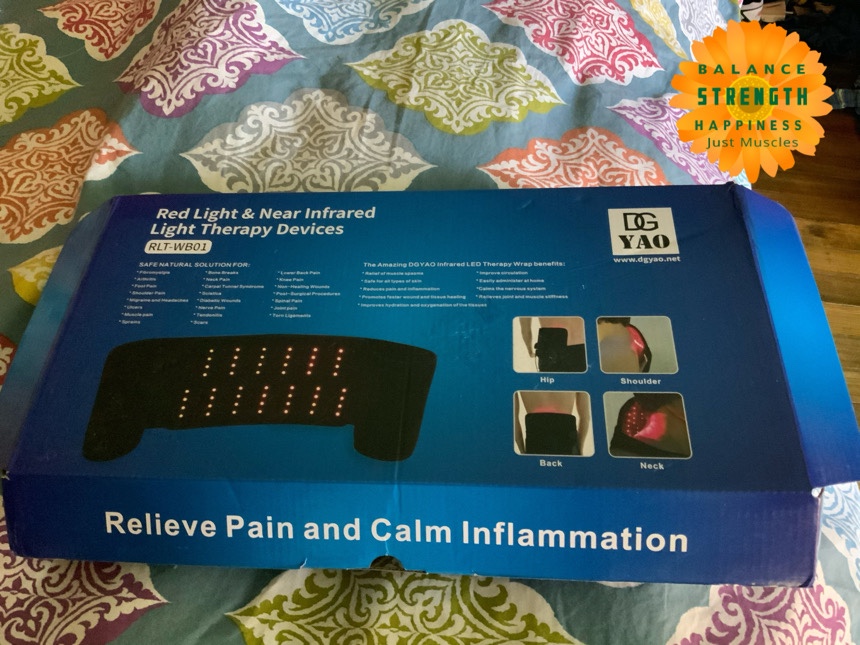
I discussed this at length with my dear friend and incredible massage therapist Kim Dewey (Heartsongforhealth.com) She like Margaret had been using infrared light with her clients and she gave me the fantastic Dgyao wrap for my birthday.
When it arrived my husband opened the box, whisked it away to his office, and immediately starting zapping (and when I say zapping you can’t feel much other than a gentle warming) his low back. I hadn’t had a chance to even look at it closely! I asked him a few days later how he liked it and if he thought it worked. He is a scientist, and usually gives a well thought out long-ish qualified answer, but in this case he simply said, “yes!”
Next thing you know I was “inspired” (read: challenged by a client 🙂 to get 50,000 steps in one day. That’s 23.75ish miles for the day of running, walks with the dog, extra running, and more walking around the block and house until 11:15pm to get all the steps in. I did all the things I usually do after exercise: roll, cold shower, scrub, etc.
However, the next morning my legs were sore. I figured it was just par for the course and that’s what I get for being competitive. Out of the corner of my eye I saw the wrap, and grabbed it and put it on my legs over my running tights. It has an automatic shut off feature after 20 minutes, and the official directions say to put on bare skin for 20 minutes. I had done the sauna for an hour with clothes on, so I decided to keep hitting the button until I was at an hour.
I stood up from sitting through a hour FaceTime call while I was zapping, and my legs were fine.
Fine.
As in: Not Sore At All.
As in: Oh You Did 50K Steps Yesterday? No Big Deal.
WOW! This was astonishing! I had no idea that would be the result.

Sadly, my third game back to futsal (Indoor soccer with a smaller heavier ball) I twisted one way, stepped the wrong way, and felt my ankle pop. Darn it! I hadn’t twisted my ankle in a long time, but I had done it many times in the previous decades, so it wasn’t a new thing. I did forget how much it hurt, and I dreaded the thought of losing all the fitness I had worked so hard to achieve over the pandemic.
Professional athletes ice for 20 minutes every hour, and I decided to act like a pro with a small twist. Instead of waiting the traditional 72 hours of pure icing, I would jump into what’s called “contrast baths” right away to take the pain out. Historically that meant 3 minutes in an ice bucket, followed by 90 seconds in a tepid (not hot and really just barely warm) water bucket. However, my ‘tepid’ would be the wrap.
If I wasn’t icing, I was zapping….all the next day. 24 hours later, I could walk without a limp, there were no crutches in sight, and the pain was extremely manageable. It was so manageable I did not take any Tylenol or Ibuprofen at any time (honestly I forgot to, but I prefer to not take anything if at all possible).
This was all ice and infrared healing, as an accidental experiment.
A successful experiment!
Do your research, but I am impressed with this modality. I like the wrap with the auto shutoff feature, the fifteen foot cord, and the convenience of being able to lie down comfortably and have healing happen and inflammation reduced quietly without a roller, or a fascia blaster, or a cold shower.
Here is the video summation I put on Instagram earlier this week, if this is easier for you to absorb the information!
Have you ever used this infrared to heal or reduce inflammation? Let me know in the comments below!
Memo to myself: don’t forget to roll, scrub, stretch, or compress my quads so that my quad tendon doesn’t RUPTURE!
This is a heartbreaking story.
On Mother’s Day, I was treated to the gift of two Portland TImbers tickets to the arch rival Seattle Sounders game. It was a beautiful sunny day, and we had good seats close to the field. The Timbers missed a penalty kick and that was unfortunate, but the game was far from over and I was excited. Fast forward to the second half, and I was watching our goalie take a standard, run-of-the-mill, no one around him for 20 plus yards goal kick.

He planted with his left foot, kicked the ball with his right foot, screamed in agony, grabbed his right hip with his right hand, and crumpled to the ground.
My husband turned to me and said, “What do you think happened?”
I replied, “Well, taking into consideration the spot he grabbed I will guess the IT band or the quad tendon, especially considering they have played 5 games in 15 days.”
Turns out I was right, but it was far worse than I guessed.
He didn’t just pull his quad, he RUPTURED the quad tendon, which caused a season-ending surgery the following week.
Was this tragedy preventable?
Absolutely.

Have you ever had what you thought was hip pain? I’ll bet our goalie had this first, before the quad tendon finally couldn’t take it anymore.
Here’s what the quad looks like… This is a photo of the under layers of 3 of the four muscles:

The underneath three attach from the bottom of the knee to the top of the femur. These 3 were apparently unharmed in the goalie’s injury.

When I watched the goalie clutch his hip as he went down I had a sinking feeling it was that 4th quad- the “rectus femoris” tendon. It attaches to the front of the hip and the tendon is yellow in the photo above. I have had several clients tell me they have “hip pain” but then point to where that quad attaches. I always say, “That isn’t hip pain per se, but instead just a REALLY TIGHT quad.”
That was what ruptured.
I can’t imagine the pain.
So how do you prevent this from happening to you?
Here’s the key: The red part of the muscle is the actual muscle belly – this is the part that has the potential for flexibility or the potential for tightness. You need to target this area. It is safe to say target the middle of the muscle.
How? You roll, you stretch, you cross fiber massage or what I call scrub, or compress and hold the roller on the quad. I am forever “beating on” quads as they get tight fast and drive me bananas.
Most people find that the tightness is especially bad on the outside quad, and refuse to roll it because it is so painful. If you fall in that category, try working on it with the rolling pin from your kitchen.
Do not roll if it causes you horrible pain, as the horrible pain actually makes your body release cortisol (the stress hormone), and the net effect of the exercise might not be beneficial. Chip away at it slowly, maybe using the rolling pin as an entry point.
Here is my client Holly showing us the classic roller position to roll quads…you can go up and down with the “grain”, or across the grain, or just put the roller on a tight spot and stay still. Roll, scrub, compress.
The other half of the exercise would be to then engage the hamstrings which are the antagonists of the quads. You need both: a little release of the the quads, and a little engage of the hamstrings. More on the hamstring part later, as that is it’s own blog.
Rupture? Totally preventable. Totally unnecessary. Such a tragedy.

Follow me


Copyright 2022
JustMuscles.net