

Why am I suddenly snoring?
Once upon a time I was married and turning 40. All of a sudden my (now former ) husband starting telling me I was snoring. I was horrified. With my background, I immediately suspected my structure or posture was off. After all, I had been bending over and living with small frys for a decade now, and surely that had taken a toll on my posture? However, nothing I did structurally seemed to make a difference.
To add injury to insult, I also started having night sweats or ( god forbid was I really that old??) were these hot flashes? Wherein I would wake up in a instant sweat, and then cool off, and then be cold and mad that I was a) awake b) cold c) mildly to severely damp. What the heck was going on? Why the sudden changes? It didn’t happen every night. Was this really what I had to look forward to: decades of interrupted sleep and grumpiness in the middle of the night?
Oh joy! 🙁

Then I decided on an external environmental elimination process by changing one thing at a time in the room. First, we had just put a foam topper on our mattress. Took it off. Helpful? No, same sweaty. Second, how about my pajamas? Went back to cotton… Still sweaty, still snoring. Third, I read a magazine article about hormones changing in women over 40, and something about how that changed the tongue, and caused it to fall back in the throat, causing snoring. Hormones? Hmn. Considered looking into that. Fourth, I changed sheets, again back to natural fibers and really nice cotton.
Nope, didn’t help. Nothing helped.
There went my environmental theory.
Are hormones to blame?
What could it be? Hormones get blamed for everything, but I wasn’t that old, was I?
Then one day, I met Margaret Floyd Barry, as she is now known. We had done the same workshop on different weekends and now were part of a group to expand on what we had learned. I liked her instantly. Brilliant businesswoman, nutritionist, and lover of all things naked…as in unprocessed, whole, organic foods.

My friend Margaret Floyd Barry
She suggested I try her “sugar control” program for two weeks to test it out. What was this? In hindsight, this program turned my life around. However, I looked at the list of everything I couldn’t eat, and was immediately unhappy about most fruit missing. I got over it, especially when she pointed out it was only 14 days. I could have half an apple and some berries. Mostly I was to eat as much protein and veggies and fat as I wanted as often as I wanted.
Hmn. Okay, I guess so. If I have to, to help the testing process. 🙂
First seventy two hours were super rough, but I had tons of veggies on hand and I just kept stuffing them down. No crackers or bread? This was new. I managed to get through the first week, and suddenly realized I had slept through the night. No sweating. No angry middle of the night cursing. No complaints of snoring.
WOW!
Why detox your body?
The interesting thing about an elimination diet, or detox, is that you get to add things back in and see what they do to your system. Gluten foods gave me a stomach ache, so now I avoid those. Carbs other than fruit and veggies give me an instant runny nose…and I go back to sweating and snoring pretty quickly. One holiday cocktail season just after my divorce I hit the party circuit hard for about six weeks. Even though I run nearly every morning, all those drinks and treats landed me with a sinus infection….which in my opinion was a runny nose on refined carbs for six weeks.
Super interesting, eh?
Then I read Wheat Belly by William Davis, MD, who wrote that wheat binds to the same receptors in your brain as endorphins do when you exercise. That makes it addictive. I now refer to bread at my house as “crack”. My poor children are teased at school because they don’t have normal sandwiches in their lunches, and I insist on as much as possible be organic. I tell them I don’t know why people eat bad food, and that the other mothers must not love their children as much as I love them. 🙂 They still complain. (Here is a link to his book)
Do we eat that way all the time?
No.
However, I know I am getting through to them, because one day my oldest daughter came home from a five day trip to a soccer tournament. Later that week, she had a game to play, and afterwards was clearly exhausted and hungry. I mentally ran through my options. She needed food, and quickly. Instead of turning right towards home, I turned left and headed to Burgerville, which at least sources its beef locally and sustainably. As I turned into the parking lot, to my great surprise, she burst into tears. “Mom! I’ve been eating crap food all week! Please take me home and feed me something organic!”
You bet, sweetheart.
Detox options
I also have had the good fortune to deepen my knowledge on nutrition by listening to lectures for the last decade by Club Sport’s regional nutritionist Laura Bartron. She is also a smarty, and has very carefully put together her most recent detox…what she calls the Detox Box.
This week long program uses supplements, two dairy free shakes a day, cleanse powder, and a meal plan to assist Club Sport members in safely detoxing. I have tried three versions of her detox in the last few years to help me get re-unhooked from refined carbs ( when will I learn? 🙂
One main difference between the two from my perspective is that Laura’s program uses shakes and supplements, and lasts a week and Margaret’s uses all food and lasts two weeks or longer. I have lost 7-8 pounds each time I have done a detox. Was it water weight? Well, it takes 4 grams of water to store 1 gram of carbohydrate, which gives you that puffy bloated feeling. That was gone!

Club Sports Detox Box

My 82 year old client Juanita enjoying her garden
I can’t tell you how much I recommend using food as a tool to help with your overall health goals. So many things are chalked up to getting older– the sluggish energy, the crazy sleep, and the lowered immune system, to name a few. Don’t put up with that! If that was true, (the “oh, I’m getting older” thing) then how do you explain the crazy fun energetic eighty two year olds like my client Juanita?
Hah! You can’t.
You can detox
So get out there and DO something about it, right now. If you are lucky enough to be a Club Sports member, grab that Detox Box in the pro shop and give it a try. How about just taking one potentially problematic food out of your eating regime…for instance, gluten? Or white sugar?
Additionally, Margaret and I are scheming up a great combination program whereby you can get the best of both our worlds.
Detox offering
Keep your eyes out for a special BlackFriday/Cyber Monday announcement, and more to follow in the New Year.
Stay tuned for a special interviews with specialists in their fields coming up in the next weeks!
A request to review a book
A long time ago my nutritionist friend Margaret asked me to review a book, which she was even kind enough to give me to read. I scanned a few pages, caught what I thought the general gist was, and forgot it on my bookshelf for awhile. However, I think the author’s premise is worthy of time and exploration. She essentially lays out her basic plan in the first chapter. (more…)
Know yourself
Last week I had the unexpected pleasure of attending a workshop put on by man by the name of Rodney Corn. Rodney’s whole presentation wasn’t based entirely on the latest training techniques and tips, but instead, psychology. His essential theme was “know yourself ” and “know your client”.
I find that delving into what makes you tick helps you better interface with the rest of the world, and this was a topic I have spent some time exploring, so I listened intently. I currently read Gretchen Rubin’s happiness project blog, Sally Hogshead’s fascination advantage blog, and various and sundry other examiners of habits, personality strengths, and weaknesses.
For example recently, Gretchen Rubin talked about the habit of abstaining. How to her, completely not doing something – or – completely doing something wholeheartedly, was much easier then another habit that other people find themselves using: the habit of moderation.
I have beat myself up for years not really being very good at moderation and wondering why or what was wrong with me. Now I know, with great relief, that completely staying away from something is much easier than trying to do it moderately.
For instance: chocolate. My sweet boyfriend eats about two dozen chocolate chips after dinner almost every night. I honestly don’t know how he does it, and is satisfied with that. I would rather eat tons of them until I feel full, but that doesn’t work for me for a number of reasons, so instead I skip it entirely.
This also allows me to claim what I call “complimentary skill sets” with my sweet boyfriend. He is good at one thing, and I am good at other things. Moderation is not my strong suit.
Back to Rodney…
Rodney had us take the test below. Even better, he said, was to have someone who knows you fill it out for you. Have you seen this before? I had seen something like it, but not exactly this.
Get out your pen and pencil! Put a check mark next to the word that describes you most accurately.

Then add up your scores in this tally box. The question is: do you have a predominant trait that pops out and has a higher number than the others, or are you a blend, or are you half-and-half?

Are you a driver? Here are some of your classic personality traits:

Are you an analytic? Here are things that define you:

Are you expressive? Here are mannerisms and ways of being in your world:

Are you amiable? Here are characteristics you find traditionally with your people:

Now: why is this important?
At this point our presenter started acting out two sides of a role play situation and had us in stitches in the ridiculousness of it all.
Let’s say an amiable person hires a analytic personal trainer for a few sessions.
Amiable people tend to be vocally softer and slower, they like to focus on people, tell a story or two with open hands and in a relaxed, casual posture. Analytical people tend to also talk slowly, but they want to focus on the task at hand, and cite statistics and evidence with their hands closed in a much more rigid posture. What happens when these two people get together to work out?
The analytical person is ready to boom boom boom knock out some tasks with generally very traditional exercises. The amiable person says, “Hey let’s tell a story in between exercises …why are we counting? Can’t we just do this for time? How about we try that Bosu ball thinggy on one foot with a sandbag in the opposite hand?” 🙂
At this point in the workshop we were all on the ground laughing because we had all been there as trainers with our clients. One person is looking at the other person like they are complete aliens. Do you think this makes for a harmonious situation? I think not unless you recognize what is working for you and working for your client.
Can you see how knowing what makes you tick and how you roll is useful in a training situation? When you go to hire a trainer? On a date? With your banker? Talking to your neighbor?
Can you see how this is useful to know with-*gasp- all the relationships in your life?
Recently I received this feedback from one of the video blogs I do for Margaret Floyd Barry’s eatnakednow.com website every other Friday. (New one coming up this Friday!)
” I’ve been getting your updates and I really like the cooky lady with the fitness tips. “
This was before I did this workshop, and quite honestly I was taken aback. I spend a lot of time making sure I have colorful outfits, that the back drop is interesting and diverse from one video to the next, and of course the information is relevant to help people with their muscles. I find trainers doing exercises on a yoga mat in a gym incredibly dull. This isn’t the only feedback I have gotten from that venue, but at first I thought, “Wow, none of the rest of the stuff that I thought was important was getting through. It wasn’t informative? It wasn’t helpful?”
No, I was just kooky. 🙂
What I realize now is that person has a different social style than mine, and that is just fine. I also realize is that I do need to tailor my videos to appeal to the analytical people of the world, for instance, because that’s not my personality style naturally.
That’s going to take some work. ( I do love you engineers, don’t you worry! I didn’t know! I promise I didn’t know!)
In the meantime let us know if you have bumped into another personality style with success, and if not with success how did you resolve it? Did you even realize what was happening?
Fascia and your muscles
I have spent the last year or two learning about a little-known tissue previously unresearched and otherwise very misunderstood. It’s called fascia. The way I describe fascia is is when you have chicken and you pull the chicken skin away from the meat; there’s that white fibery stuff that connects the skin to the meat.
That is fascia. It encapsulates every muscle, wraps every organ, connects your skin to your bones, infiltrates the muscles, infiltrates the bones themselves …. it is everywhere inside your body kind of holding it all together inside. It tends to accumulate more densely on the back and the outsides of the bodies rather than the front side or the inside of the body. It has something like seven times the elastic property of muscles and 16 times the tensile strength of muscles. Up until a few years ago it was the stuff people just cut through to get to the bones, the organs, or the tissue that needed attention inside. No one thought it had much to do with anything. Now that has completely changed.

Use a golf ball to roll the bottom of your feet for 15 seconds
A year ago I sat through a presentation on what was titled “The Fascial Frontier.” In that workshop my friend and chiropractor Matt Hemsley describes how a German anatomist had discovered what he was calling ‘Fascial Trains’, through the body – seven of them. His name is Thomas Myers and he has written a book called Anatomy Trains.
In this workshop we were invited to just try leaning over and seeing if we felt tightness in the back of our legs…specifically the hamstrings. Matt then offered everyone a golf ball and we were to roll the bottom of our foot on the golf ball for 30 seconds. In a classic before and after test, we were then to lean over and see if we were looser in our hamstrings.
Try it.
I was looser, how about you?
Matt then said, “is it tight hamstrings or is it a tight posterior fascial line? ” Hmmm.
Fast forward to last December. I found out about another fascia workshop that was scheduled to happen on a Saturday three days beforehand. I could only attend half the workshop because of previous commitments and my daughter’s birthday, but I went anyway. These presenters flew in from Santa Barbara, and described how fascia was in my words kind of a silent strangler inside the body – it’s everywhere.
The problem with fascia
The problem with fascia is that it does not have any direct connection to your brain. Muscles have a direct connection to your brain via the nervous system. The other problem with fascia is that it has 16 times the tensile strength of muscles, but you don’t even know that it’s causing a problem, because it has no connection to your brain. It tends to accumulate densely on the outsides and back sides of the body, not so much on the front sides or the insides of the body.
When it wraps itself in and around the muscle and accumulates densely it tends to start locking down the muscle itself. All you can feel is the restriction it places on the muscle by not allowing the muscle to fully contract or fully lengthen. Not much research has been done on fascia up until a few years ago, because everybody thought it was kind of useless.
Now it turns out it’s of huge importance to the body!
I was lucky enough to attend a PTA Global presentation by Rodney Corn recently. Rodney’s approach to fascia is not so much to go after the muscles themselves, which is a somewhat complicated process that the gentlemen from Santa Barbara are still attempting to help me learn, but instead we go directly after the attachments to the bones. The muscle tugs on the fascia, and if the fascia can’t move then the muscles will keep tugging…unless we break loose the attachment points.
Scrub them, if you will. 😀
With this technique you do not want to “scrub” the joints for more than 15 seconds, and not more than once a day. You’re trying to promote lubrication to the joint itself, but too much friction will cause the joint to be irritated. The other thing that Rodney had us do in between every two attachment point releases was to try an overhead squat. Did the overhead squat feel looser as we loosened up points along the body? Overhead squats are very simple: all you do is hold your hands over your head and break down into a squat.
This is my friend Matt demonstrating an overhead squat with the roller we used in the workshop for “scrubbing”.

Wanna try?
It doesn’t take long : that’s the nice part, and be sure and follow that 15 second rule.
Let’s get started!
We will hit a number of attachment points:
- The outside of the ankle just above the ankle bone
- The outside of the knee just below the knee
- The hipbone from the front
- The pubic bone
- The sacrum
- The sternum right across the bra line, and
- The shoulder blade.
Here is my coworker Steven doing the outside of the ankle. You scrub across the ankle, back and forth somewhat vigorously for 15 seconds.

Here he is working on the outside of the knee, side to side.

Here he is scrubbing that pointy part of the front of the hip bone. You simply move to the middle of the hip and scrub the pubic bone from there in that same back and forth motion…careful, gentlemen!

Here Stephen demos the sternum. Gently, but firmly!

Finally, scrub the inside edge of the shoulder blade like a bear scratching on a tree with your arm held out.

Whaddya think? I don’t know about you, but as soon as I released the sternum a huge gush of blood went down the back of my spine and my shoulders opened up immediately. I loved it.’
Rodney explained that the frontal fascial train was pulling us forward and we didn’t even know it.
That’s not to say the sternum is the only place to release- you need to hit the spots on the way up as they all work together.
Let me know how this release technique goes! Be willing to chip away at the tightness you very well might find. It is a process with this magnificent body system of yours!
Static Stretch?
I was watching my older daughter’s soccer team warm up the other day, and I loved what they were doing, until they stopped all movement and plopped down for some good old fashioned static (held) stretching and chitter-chat time. My heart sank.

Girls executing very static, long hold stretches
It reminded me of that same sinking feeling a few years earlier watching the Portland Trail Blazers warm up pre-game. What on Earth were their trainers doing out on the court executing many a held stretch, right before those boys had to go out and perform explosively? Didn’t they read the research?

More of this team’s limited movement warmup stretches
Research backs up experience
Granted, researchers change their mind every 5-10 years. However, I had personally experimented with both techniques (static- holding a stretch for an extended period of time, and dynamic- moving and not holding any movement for more than approximately 2 seconds) and thoroughly agreed with the dynamic camp as the better choice for a warm up situation. Interestingly enough, the Blazers became infamous for their quantity of injuries that season. Here is what I am talking about, quoted from medicalnewstoday.com:
“Contrary to the prevailing idea that stretching enhances athletic performance, a new study by UNLV kinesiology researchers found that certain stretching may actually reduce performance by decreasing leg power. The study, which appears in the September 2008 issue of the Journal of Strength and Conditioning Research, investigated how two typical stretching techniques for the hamstrings and quadriceps muscles in the legs affected measures of strength and power in a group of male and female athletes.
Specifically, participants were asked to perform a vertical jump and seated knee flex on three occasions after a typical duration of basic static (holding) and ballistic (bouncing) stretches, or no stretching at all. While little or no difference was found in vertical jump and leg torque, power measures for the stretching groups were significantly reduced.
“Athletes typically include static stretching as a part of the warm-up, but the evidence is clear that this practice will decrease performance in sports that require explosive movements,” said UNLV kinesiology professor and study co-author Bill Holcomb, who directs the university’s Sports Injury Research Center. “Developing flexibility is important for reducing sports injury, but the time to stretch is after, not before, performance.”
Thank you, Mr. Holcomb. This came out in 2008! It is practically ancient history!

Bogglingly comprehensive
The New York Times reported this more recently in April of 2013:
“Those findings join those of another new study from Croatia, a bogglingly comprehensive re-analysis of data from earlier experiments that was published in The Scandinavian Journal of Medicine and Science in Sports. Together, the studies augment a growing scientific consensus that pre-exercise stretching is generally unnecessary and likely counterproductive.
Many issues related to exercise and stretching have remained unresolved. In particular, it is unclear to what extent, precisely, subsequent workouts are changed when you stretch beforehand, as well as whether all types of physical activity are similarly affected.
For the more wide-ranging of the new studies, and to partially fill that knowledge gap, researchers at the University of Zagreb began combing through hundreds of earlier experiments in which volunteers stretched and then jumped, dunked, sprinted, lifted or otherwise had their muscular strength and power tested. For their purposes, the Croatian researchers wanted studies that used only static stretching as an exclusive warm-up; they excluded past experiments in which people stretched but also jogged or otherwise actively warmed up before their exercise session.
The scientists wound up with 104 past studies that met their criteria. Then they amalgamated those studies’ results and, using sophisticated statistical calculations, determined just how much stretching impeded subsequent performance.
The numbers, especially for competitive athletes, are sobering. According to their calculations, static stretching reduces strength in the stretched muscles by almost 5.5 percent, with the impact increasing in people who hold individual stretches for 90 seconds or more. While the effect is reduced somewhat when people’s stretches last less than 45 seconds, stretched muscles are, in general, substantially less strong.”
I couldn’t have said it better myself! Why in the world would you want your muscles less strong before you start exercising? You don’t! It is bogglingly the wrong thing to do! (Don’t you love the word “bogglingly”? I just had to use it in my own sentence! )In summary: dynamic movement for your warm up, please! Have a favorite stretch? Only hold it in 2 second increments pre game, pre run, or pre workout. Don’t be counterproductive.

A better way to warm up with short periods of stretching
What about cool down?
Notice the reference to 90 seconds in the quote from the New York Times. Interesting. Remember my habit of tagging along on interesting sounding PT appointments?
This particular PT, whose name escapes me at the moment, told our mutual client that the nervous system starts not only to release, but to reset at 90 seconds. It is my understanding that when you warm up, you are trying to increase the number of NMUs (neuromuscular units– one nerve fiber with one muscle fiber) available, and when you hold that stretch for 90 seconds, you decrease your NMUs and start to quiet your nervous system down.
You can also use this technique for trigger points. Find a hot spot and dig in, but more importantly hold that compression for the full 90 seconds. I am not a big fan of much inbetween. Don’t ask me to hold something for 30 or 45 seconds. That seems silly, and doesn’t do nearly the amount of good as 90 seconds.

2 or 90
Give me good reasons for other numbers because I haven’t seen any.
I am that girl in yoga who is 5 or 6 positions behind in the class, because I want the full release and reset from the pose. Don’t you want your body to learn that new stretched length? It seems to me that is the whole point. However, I have a hard time in Yin yoga. Yin yoga go-ers tend to hold their positions for 5ish minutes, and if it’s a warm room with a good story or thoughtful thought being murmured by the teacher with blankets involved… oh dear. I have been known to fall asleep. During class. 🙂
If the point is relaxation, they did it! I was so relaxed I conked out! It is only mildly embarrassing. 🙂
2 or 90. It is really easy to remember!
Is that how you stretch?
Let us know in the comments below!
The other day I had a funny conversation with my sweet boyfriend. He said, “My wrist hurts!” I gave him a quick once – over and noticed that not only was his hip out of position but so was his shoulder. I looked up at him calmly and said, “it’s not your wrist,” and went on with eating breakfast.
He’s now starting to get used to conversations like this, so he smiled at me indulgently and said as he was wiggling his hand around, “But my wrist hurts!” This time, I looked at him squarely in the eyes, took a deep breath, and said again, more earnestly this time, “It’s not your wrist.” This time, I explained exactly what I had noticed: that his shoulder was out of position and his hip was elevated on one side. I’m not entirely sure what he said to me in response to that but it was the equivalent of, “So what?”
It reminded me of conversations that I’ve had with my clients over the years and how I have successfully (and unsuccessfully) argued my position and observations with the client(s) who want me to focus on the symptom(s) that hurt. One day I was finally rewarded with a conversation that started like this: my client Mike walked in and said to me, “My knee hurts. I know it’s not my knee, but my knee hurts today.”
Aaah. Happiness! Breakthrough! He gets it!

What exactly did he mean by that?
The world seems to want to focus on the symptom of the problem and not necessarily the cause of the problem. In the case of my sweet boyfriend, I had him lie longways on foam roller, do some hip exercises, shoulder blade exercises, and then get up after about 20 minutes. I then asked him, “How do you feel?” His hip and shoulder position were significantly better, by the way, and as he started to wiggle around his hand he said, somewhat surprised, “My wrist feels better!” He knit his eyebrows for a second as he said, “But we didn’t do anything to the wrist itself!?”
(Point! Set! Match! 🙂
I resisted the enormously great temptation to say “I told you so!” and instead sweetly smiled, saying,”It wasn’t your wrist! It was never your wrist. Your wrist was just feeling the ramifications of a shoulder out of position sitting on top of a hip out of position.”
The proof is in the pudding! His wrist was better, and we didn’t ice his wrist, heat his wrist, massage his wrist, ultrasound his wrist, paraffin his wrist, manipulate his wrist, laser his wrist, exercise his wrist, or adjust his wrist.
The wrist wasn’t the problem!
The wrist does what the elbow tells it to do, and the elbow is subjected to what the shoulder says to do, and the shoulder has to sit on top of a hip, which really has the ultimate say. Sometimes the thing that hurts is actually the problem, but if you aren’t getting anywhere with just addressing what hurts, I invite you to look elsewhere.
The same thing happened to me recently.
Over the last couple weeks, my sweet boyfriend has very patiently been taking me out onto the river to learn to kite board. One of the things you have to learn to do when you kite board is occasionally completely let go of the bar. It is attached to your harness at one end and via strings to the kite at the other; doing so allows the kite to decelerate and de-power. If you don’t let go to decelerate and de-power the kite, and let’s say a gust of wind comes along, you tend to get yanked, hard, and sometimes completely off your feet!
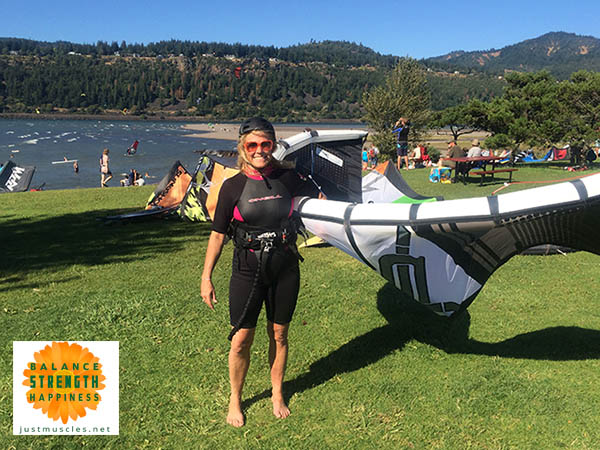
For a few weeks, when people would ask how kiteboarding was going, I would reply that I was an unbelievable face-planter. 🙂 This happened on many, many consecutive attempts. His comment to me at the time was, “You just caught more air than I ever have! You sure want to hang on to that bar, don’t you?!” Well, two days later when second day soreness hit, my ribs and abs ached, and my right shoulder was really really really sore. It was a busy week and guess what: I ignored it for a few days. Then guess what happened?
Karma, baby.
Wrist Pain Again
Interestingly enough, my shoulder was now ‘fine’, but my wrist was paying the price. It was really sore. Not wanting to bend to ninety degrees sore, no grip strength sore, no push or pulling sore. I was genuinely worried for about five minutes. My thoughts raced: I can’t have a non-functioning hand….I have an active job! I need my hand! After my thoughts ran away from me in a panic, something sticking out caught my eye. I looked over at my right shoulder, and I thought, ‘my goodness, what is it doing way out there in front of the rest of my body?’ Dummy. What happened as soon as I fixed that shoulder position?
Boom.
The wrist was fine!
Deep breath.
All was well, again.

What was the resolution with Mike and his knee?
Well, Mike tends to get super tight adductors (inside of the thigh) from running many miles during the week. If your adductors are tight, they can pull on their attachment points at the knees, causing knee soreness. The bigger problem is that adductors’ antagonist is my ever favorite glute muscle, and they get knocked out of the picture. If your glutes don’t work, your body will go above or below the joint to find the nearest neighbor to chip in and help. Usually the body goes above the joint, into the back, and that makes backs sore. Additionally, remember that muscles are just like people: they do their job AND someone else’s, and they will complain. Complaints= pain/tightness/stiffness/soreness.
Yuck to all of that; and completely reversible!

Have you ever figured out that your symptom wasn’t the cause? Tell your story here please, so that our loyal readers might benefit from your experience!

- Don’t wear orange or black, especially if you are on a team. Those are official Tough Mudder colors and you will blend in. We stuck out distinctively in green and found each other easily. If you are doing Warrior Dash, stay away from black and red. You get the idea.

- Plan on getting really muddy, and then sometimes clean, followed by muddy again. Here I am ready to dive under the log for this obstacle.

Yep, I slipped and fell headfirst. Those are my feet in the air on the right. 🙂

This is what we looked like after that obstacle. Aren’t our nice green shirts distinct? Ya, right!

- Don’t wear your hair in a ponytail. Ponytails get stuck on barbed wire and yank heads back, simultaneously cutting down on army crawling speed. I switched to pigtails immediately after this obstacle. 🙂

- Do this kind of event with a team. It is nearly impossible to get thru many of the obstacles by yourself. The race directors create an environment that promotes teamwork, which adds to the fun. If you do fly solo, the mantra is “help your fellow Mudders”, so don’t be shy! Ask for help, and offer help.

- Plan on getting backed up a little at obstacles and standing, in this case, in a giant trench of-you guessed it- mud!

- If nothing else, work on your flexibility and use everything you can find in or on the obstacle to tackle it and climb on over!

- Our team captain wore kneepads, shown here loose and near his ankles. My knees were very scraped up after the run and that might be a good call next year. Also, my socks were full of water and dirt, and they were thrown away about a third of the way into the race, so I would skip socks next time. Gloves and compression shin sleeves also seemed to be water/mud magnets and my teammates ditched those as well. My shoes took the toll of all the downhill running and blew out on both sides. They are also in the trash now, and I didn’t wear my favorites as I had a sneaking suspicion that might happen.

- Plan on getting your mileage in. See that hill in the background? We ran up to the radio tower you see in the distance. 1000 feet in approximately a mile, around mile six. With poison oak on the trail. This race runs anywhere from 10-12 miles with 20-25 obstacles. That hill was pretty tough.

- Crawl, and crawl, and crawl some more. Baby crawl, bear crawl, army crawl….you will use them all. Repeatedly. This is me crawling over the finish line. I was expecting more upper body work and worked out on monkey bars a bunch, but because they change the course each time, we didn’t have any really challenging upper body obstacles. Those yellow strings hanging down are the famous Electroshock Therapy, the final obstacle. Yes, they are electrified, yes, I crawled thru watery mud just prior to dashing through, and yes I was shocked twice. However, I lived to tell the tale!

- Have fun! Who has time for anything else? The beer actually brings up an interesting point– you obviously don’t need alcohol to celebrate your success as the race is it’s own reward; however, it did come in handy for post race refueling. I stashed some Glutamine (an amino acid, of which 8g translates to the equivalent of eating 60g of carbohydrates) in my sports bra in a ziplock bag, and dumped it in my water mid-race. Since we were out on the course for 3.5 hours, seriously consider how to handle the hydration and fueling needs to keep from bonking or overheating.
Do you have any adventure racing tips or crazy stories for our Just Muscles loyal readers? Please, give us your secret for success and make us laugh!
Thank you to our friend – Mrs. Penner-Ash for taking the photos and allowing us to use them here.
Don’t blame the sport.
Blame the body you take to the sport.
Continuing on the theme of if you can’t tell me if a muscle is working, it isn’t; please don’t blame the sport you love on why your body hurts. It usually goes something like the following: “Weeeeellllllll, I used to run. But then my knees hurt, and kept hurting, and no matter how much ice and ibuprofen I used they wouldn’t stop hurting, so I stopped. I rested for a couple weeks, and tried again, but they hurt again, right away. I asked my neighbor, and his knees hurt because he used to run, too. My friend stopped running because her knees hurt before and afterwards. Although I love it, and he loved it, and she loved it, it’s really hard on your knees- all that pounding- and I am getting older, so I don’t run. Love to run, but my knees hurt; so I stopped.”

Stories like this break my heart.
The interesting thing is, it rarely stops there. This same person will often continue with the following: “Then I played racquetball. It was fun, and I really liked it, and I even got involved in a league, but apparently all that bending and twisting and spinning and whirling wrecked my back. So I stopped playing racquetball.”

“What could I do now? I decided to take up golf. Seemed like a nice, low impact sport. However, even when I play golf now, both my knees and my back hurt, and couple of hours after a round I find myself back to the ice and ibuprofen regime. I thought to myself, well, maybe I just need to try something really low key like knitting, but honestly, even that bothers my neck. I have gained weight and I can’t keep up with my grandchildren and even the thought of gardening strikes fear in my heart for fear of the body part that will hurt after!”
It is remarkable to me how frequently I hear variations on that theme: I want to do this, but my _______ (fill in the blank) hurts and I can’t. My goal for everyone is to do the things you love, not live in fear of the things you love to do. If you want to ski, do it! If you don’t want to ski because you don’t like being cold and the mountain holds no appeal, then don’t ski, but no matter what I want the option available to you. The other word that is key in that phrase is the word “can’t”, easily my most unfavorite word in the world.
You CAN!
I allow my clients to express the fact that they are “having difficulty”, but under no circumstances are they allowed that verbiage choice. Ever.

So that we are perfectly clear: Let’s get those muscles working so you can get back to the things you love.
Your doctor might say something like, “if it hurts, don’t do it!” We can take his\her advice for the short term, but let’s see what we can do for the long term. Additionally, lots of people like to blame the place they are in life as part or all of the problem. “I am getting older, you know”, is another reason I hear. However, if age were the issue, then you wouldn’t see 80 year old marathoners and skiiers out on the mountain. If age were the issue then all the people your age should have the exact same problem. They don’t. You don’t have to either.
Don’t buy into the “I am getting older, you know!”
What a bunch of hogwash!
What about the male/female difference? Well, if it were a gender issue, then all women or all the men you know should also have the same problem with the same sport. They don’t.
Why?
Aaah. That is the question. Why? Please ask that question of yourself, over and over. Now, if you have a legitimate orthopedic concern– no cartilage, bone healed wrong, missing chunks of tissue, etc., then I agree you have a condition to work around. (but even then I have seen cool things happen as those conditions often happen as a result of out of balance muscles!) As for the rest of you? I suspect that you have a bunch of muscles going heavily underused, and a few going heavily overused, and that is the body you are taking to your sport. Out of balance, making assumptions that all of your muscles are on board, and then after feeling horrible the next day, deciding that running/skiing/golf/etc etc is just not going to work anymore. Onward to croquet!
Please. Don’t give up! Be in the perpetual pursuit of muscle balance, so that you can be 82 and out doing the things you love like my inspiration Juanita below. She has been my videographer on a number of Just Muscles video adventures, including this trip to the tulip fields. I want to be just like her when I grow up! Look at that sparkly smile!
Let me know if I can help, and leave comments below on what you are going to do to stay in the game!

I can promise you this: When I ask a client if he\she can tell me definitively if a muscle is working, and the answer is, “I think/guess/assume so,” or “well, shouldn’t it be?” or “I don’t know, but I’m sure it is”, the answer is NO. Not one bit! Most people operate on the premise that most all of their muscles are working for them all of the time. Generally speaking, they are shocked to find that that is not the case. My rule of thumb is, if you can’t feel it working, it isn’t.
That begs the question, how did that come to be?
Well, and we have talked about this before, you have to remember that muscles like to work in pairs. For instance, in your arm your bicep has tricep, stomach has back, and in your leg quads (front of the thing) have hamstrings (back of the thigh). If one of those muscles works, then the other muscle in the pair relaxes. That is how movement happens: one muscle contracts, and the other muscle relaxes, and when you move back to the starting point the reverse happens.
Take the bicep for example: you bring your hand toward your elbow, and the bicep contracts. You extend your hand back away from your elbow and the tricep is supposed to contract as the balancing or paired muscle.
Unfortunately, this is not always the case. Why? Why for instance do most all of the ladies that come to workout want to get rid of what I fondly refer to as the “kimono” hanging down from the back of their arm? They have given up on sleeveless dresses and tank tops because that part of their body just won’t tone up. Why?

Always ask why.
Let’s say one of the muscles continues to work because you do the same thing over and over with it. Let’s say you are a mom and you have to pick up small children and rest them on your hip to carry them. In order to keep them on your hip, you have to curve your arm around their little back to keep them in place while you stand or walk. What muscle holds that kiddo on your hip?

The bicep on the front of your arm. Let’s say you find yourself like Margaret above not only picking up your small children but other small children and groceries and dog food and this goes on and on for five or seven years or twenty years. Or longer! What muscle are you using the whole time? The bicep. What muscle gets strong? The bicep. What happens to the tricep? Well, it is on hold, for a very long time, patiently waiting for the opportunity to work again. It also is probably accumulating dense fascia tissue complicating matters further, but that is a topic all on its own and another blog topic coming up. In the meantime, the brain in it’s ongoing goal of efficiency, starts to quietly shut down the nerve pathway to the tricep as it falls off the radar of available muscles. Nothing has been cut or severed or in any way, you are just developing a mild case of amnesia.
Muscle amnesia.
I am sure that I didn’t coin the term, but it is being so dominated by it’s pair the bicep, and I have seen it happen over and over and over again, that I can’t help but call it as I see it. Fascinatingly enough, even when you have identified a muscle that has fallen under the spell of amnesia, it is amazing the kind of concentration it takes to get it back on board and have the brain welcome it back onto the radar.
Make no mistake: It is possible! The first step is figuring out that it is not working in the first place. ( In the case of the bicep, the other complicating factors include the rounded position of the shoulder and what the hips below the shoulder are doing) I used to get somewhat impatient with people when I would ask them if they could feel x,y, or z muscle, and they didn’t or couldn’t tell me. Now I realize it all has to do with what the brain and the nervous system have been trained to do.
Let’s fix that!
First of all, take a look at yourself in the mirror. Really take a good look. Are your shoulders symmetrical? Is the distance from your ear to the tip of one shoulder the same distance from the other ear to the tip of the other shoulder?
Are your shoulders rounded at all, or is one side more rounded than the other? The easiest way to tell is if your seam on your shirt bisects the middle of your shoulder bone, or if your shoulder is forward of that seam.

Another way to tell is if the back of your hands face the mirror, or if you have thumb and side of fingers on the side of your hip. Again, you might have one of each.

Help!
My shoulders are rounded and I see a kimono in my future! What do I do?
First step: get yourself on a foam roller. We need to open up that whole upper back and shoulder girdle area, and let gravity help reposition your entire body because it is a system, but specifically rollers are phenomenal for shoulders and upper backs. You can watch my YouTube Video on using a foam roller here

Here is what I leave you with: Think about what, if any, parts of your body you are dissatisfied with. The next time you go to exercise, concentrate on wether or not you can feel muscles working in that area of your body.
Could you be suffering from muscle amnesia? Let me know how it goes in the comments below!
I would like to explain the difference between positional hip flexor tightness and functional hip flexor muscle tightness.
What???
I’m getting way ahead of myself, so let me take a step back, and explain why I want to differentiate between the two. Hip flexors are one of my most favorite muscles, but they get a bad reputation and seem to be poorly understood by most of the people I come in contact with. Let’s first figure out one of their main roles in the body.
What Do Hip Flexor Muscles do?
We therefore start with the question, “What exactly does a hip flexor do?” Well, there are three main muscles that can pick a leg up off the ground. The third choice of the body is the anterior tibialis, also known as the shin. If this muscle works predominately, you inevitably end up with shinsplints on either one or both legs. It’s the furthest from the center of the body and has the least amount of power, and therefore you pay the price pretty quickly and feel it being overworked (actually pulled away from the bone) fast. No fun.
The second choice in the body is the quad (also known as a secondary hip flexor) on the front of the thigh. This muscle seems to be most people’s default muscle to pick the leg up. The problem with the quad working all the time is that in the muscle pairing scenario it knocks out it’s better half the hamstring and dominates that relationship. This limits how much the hamstring can work, but that’s another topic for another blog. 🙂
The first choice to lift the leg up off the ground is the hip flexor, which is a very internal muscle. Take a look at the picture below. This is a front view of your hips, and we have scooped out all of your intestines to get a better look. The hip flexor is made up of two muscles…the psoas and the iliacus. They have the same action, and are grouped together into a blended muscle known as the iliopsoas, or hip flexor.

Image from http://kenhub.com

Image from http://kenhub.com
The psoas starts at the twelfth thoracic vertebrae ( your spine has 3 kinds of vertebrae: 7 cervical or neck, 12 thoracic or middle back, and 5 lumbar or low back) and attaches to two parts of the vertebrae itself: the body, or main thick circular part, and what’s called the transverse process or the little wings that stick out on the sides. Here is a picture of what I am talking about:

Image courtesy http://commons.wikimedia.org/
Then the psoas comes down and attaches to the inside of the top of the femur or thigh bone. Notice It literally is therefore attaching your low back to your leg via your hip! Consider now it’s best friend and partner in crime, the iliacus. This muscle lines the inside of the soup bowl hip bone itself, and attaches to the very same place the psoas does on the femur.
What is hip flexion?
So what exactly is hip flexion, and why is that important? Well, when you flex a joint you bring it closer together, and when you straighten out that same joint you are extending it. Flexion and extension, two very basic movement concepts.
Here is my daughter Sarah in hip flexion: sitting on this bench glaring at me for fear I will steal her ice cream cone.

Here is my other daughter Annika’s right leg in hip flexion going over the hurdle during a track meet.

What’s the difference? They are both in hip flexion. The hip flexor muscle is being shortened in both cases. Let’s quickly look at a picture of a hip being flexed.

Image from http://kenhub.com
Aaah, but in the track photo, one hip flexor is being functionally shortened because she is actively picking her leg up with that muscle. In the beach picture, the hip flexor is being positionally shortened simply because she is sitting. The interesting thing is the body doesn’t know or care if your hip flexor is positionally or functionally shortened…all it knows is that the muscle is shortened.
So what? Hip flexor muscles need the glute muscle!
Well, let’s not forget that all muscles have a partner in crime that they are paired with. Quad has hamstring, back has stomach, bicep has tricep, and the list goes on and on. Hip flexor’s antagonist muscle is another one of my favorites: the glute, or bottom, or juicy bun-bun. 🙂
If one muscle like we listed in one of the pairs above works all day, every day, what do you suppose happens to it’s antagonist, or partner in crime? For instance, if you walked around in a bicep curl for five years, showing off your Popeye muscle, what would happen to the tricep or back of the arm? The answer is it has to relax. It has no choice but to relax. That is the nature of its relationship with the bicep: one muscle contracts, and the other relaxes. That is how movement takes place!
Sitting is not your friend
In the case of the hip flexor if it’s partner in crime is the glute, what is the body then going to do if you sit all day? Relax the glute, right? Right. However, is your hip flexor actually working to pick your leg up? Extremely unlikely, unless you can feel it in the front of the crease of the hip working. It is shortened, for sure, but only because you are sitting all day. Is your glute working? No. It can’t in the face of a positionally shortened hip flexor…from sitting.
We already talked about how wicked sitting was from a metabolic perspective, and now here it is, even more wicked, from a functional angle.
So, what’s dominant?
This is how I find people with what I call quad/calf/ low back dominance. Your hip flexor doesn’t work because it’s positionally shortened which knocks out your glute; therefore you have no hip flexor and no glute. That leaves the quad to pick the leg up off the ground which knocks out it’s antagonist the hamstring. Now the only muscle on the back half of the body to be left working is the calf. So the calf does the work of the calf, the calf does the work of the hamstring, and the calf does the work of the glute.
If you notice: most people have pretty good-looking calves, very little hamstrings, and little to no glute, to prove my theory. If your glute and hip flexor aren’t working, the body has no choice but to use your low back as the closest neighbor, which means the low back is acting as a low back and a glute. You ask a muscle to do it’s job, and somebody else’s job, and you are going to get complaints! Muscles are just like people: they like to do their job, and not do anybody else’s job.

So tell me, do you think your hip flexors are working for you functionally? Or do you find yourself in the quad/calf dominant category?
Leave me a comment below please!
Follow me


Copyright 2022
JustMuscles.net