

How to fix one hip flexor that is sore and tight
Once upon a time there was a hysterically funny (with the most contagious laugh) lady named Bonnie. She and I worked together over the years on various muscle things that would crop up, but then she moved away across town and I didn’t see her other than the occasional party.
Now we live in the same neighborhood again and finally got together to go for a walk with our doggies Walter and Nova. The very first thing she says to me the second we start to walk is, “Laura! I’ve been meaning to call you and ask you about my hip flexor! It is SO SORE, but only on one side!” She had been doing tons of yoga, and going to the chiropractor, but it was still bugging her. Interestingly enough, this was my third sore-hip-flexor-but-only-one-side question that week, and I was sensing a trend.
My first sore-hip-flexor-on-one-side question came from my longtime ski racer and mountain biker client Gary. He had exactly the same issue, and I had exactly the same answer for both of them….
Really, the same answer could be applied to any one-sided sore muscle!
First of all, how fantastic to be feeling that hip flexor. It is one of my top three favorite muscles. Everybody know where it is? Let’s look quickly again (thank you for the fabulous app Complete Anatomy 2020 for the amazing screenshot):

Now, if the hip flexor is working, but only on one side, repeat after me:
YOU NEED THE OTHER HIP FLEXOR
(or the identical muscle on the other side) TO WORK!
So, in both Bonnie and Gary’s case, I had them stand one one foot (and hold onto something if you’d like a little help balancing) and pump up the other hip flexor. How do you do that? Watch Bonnie demo it below!
(I have her balance on one foot activating the calf/hamstring/glute on the leg on the ground as she errs to the midline of the body and lifts the non-working hip flexor side up and down not quite to 90 degrees for 1:30)
Next, you need to think about which muscle is the obvious antagonist. Here are some example antagonistic pairs to illustrate what I mean: The bicep on the front of the arm is the antagonist to the tricep on the back of the arm, stomach balances out the back, quad on the front of the thigh balances out the hamstring on the back of the thigh.
And the answer is…..
The Glutes
Our favorite glute balances out the hip flexor!
Now I simply had Bonnie and Gary walk sideways to activate the glute. You’ve seen this before…drive thru the heel as you keep your leg straight but relaxed and feel the outside of the hip/glute area engage. Try for bursts of 1:30.
Viola!
In both cases, both people felt remarkably better. No ’emergency surgery required’ as my client Suzanne says. 🙂
Therefore, next time you have one muscle hurting or sore on one side of the body, follow these simple steps:
1. Activate the exact same muscle on the other side of the body so that you can definitively say both are working equally
2. Figure out the anatagonistic muscle, and get that to engage
3. See 1 and 2 until you feel relief…and if you don’t then it might be time to seek medical attention.
It can be that simple! Let me know in the comments below when you try these tips or if you have any questions. You can do it!
The other day I was standing on a balcony in a tiny Croatian village called Rovinj, and I looked down at my feet. Normally, I look down at my feet and see that they are straight ahead, and the weight is essentially balanced equally between them.
This is important because when you go to take a step forward, the hip (hip flexor to be precise!) will hopefully lift the leg, and the knee and the foot will hopefully track straight ahead. This is good basic mechanics and what I want for all of my clients.
However, as I mentioned, I was in a tiny village and although I attempted valiantly to stay on top of my workouts, I didn’t succeed 100% of the time while on holiday, and even had missed a few intermittent days entirely.
*GASP* 🙂
One of the things I tell my clients repeatedly is that every day I get my glutes to work, and the next day I wake up and they are not working again. In retrospect, it has been a long time since I have not done some sort of glute work first thing in the morning, and two lazy days later, I find myself standing on the balcony.
I don’t often start my morning barefoot on a shiny tiled balcony listening to the birds, but I did pause to take in this glorious moment, and I noticed after standing for a bit that I felt slightly off.
I wondered what could possibly be wrong. It was such a lovely morning!
I looked down, and to my great horror, I observed that my right foot was turned out. Worse than that, my right foot was slightly forward of my left foot, and the weight was shifted onto my left side with my hip jutting slightly out to the left. Hence, the “off” feeling.

Why, you might ask, is this such a terrible state of affairs?
One of my favorite “diagnostic” tools is to have my clients observe the weight distribution in their feet as well as what direction their feet might be pointing both while they are standing still as well as when they move.
So, if my right foot is pointing out, it might very well point out when I go to move. That means instead of my hip flexor picking my leg up and my knee and foot tracking straight ahead, I might use other muscles instead…. namely the adductor muscles on the inside of the thigh slightly more.

One day: not a big deal.
Multiple days: BIG DEAL!
Remember, we are always trying to balance the muscle pairs, and what muscles are paired with adductors? Glutes! So if my leg is turned out and the adductor muscles are given an opportunity to work with every step, you can see how easy it is to have those adductors get very strong and the glute muscles very weak.
Then you have saggy useless bun-buns, and that’s no fun! 🙁
Even worse, remember how I noticed that my right foot was slightly forward of my left foot, and the weight was shifted onto my left side with my hip jutting slightly out to the left? This was easy to notice since I had tiles with grout lines to compare sides. (Wood floors work well for this, too.)
Why is one foot further forward of the other significant?
Well, it often signals rotation of the entire body…aka you are twisted. Chiropractors will tell you that rotation is one of the trickiest things to get rid of in the body.
Try lining your feet up using the edge of a tile or wood plank or threshold. If you’re rotated, often having your feet in the same plane will feel weird and you’d rather move one out and forward again.
One hip jutted out?
That means I am favoring one side over the other, and that more weight is on one side of the body. The side of the body that has more weight will most likely complain over time.
Think of the house example: if you build one side of your third floor slightly higher than the other, where will all the furniture slide? All the weight shifts to the downhill side and you’ll eventually notice.
Again: One day- no biggie. Multiple days and months and years- generally problematic.
Therefore, there are three things to address: foot turned out, one foot in front of the other, and more weight on one foot.

All this from two lazy days… which included 6 hours sitting on a ferry. I’ll guess sitting was the main muscle balance destroying culprit!
How do you fix it?
Well, you’ve got to balance those adductors and glutes. Here’s one familiar exercise to try with a few tweaks:
Glides!
- Spread your feet really far apart with your feet straight ahead.
- Bend one knee, and sink into that hip feeling the hip flexor on the bent knee side while the inside of the thigh- the adductor- stretches on the straight leg side.
- Now drive through the bent knee heel, and see if you can activate the glute to push your leg straight and back to center.
- Try for 90 seconds (the magical muscle release and reset number) and see if you can get the adductors to release, and the glutes to activate.
Good luck and let me know in the comments below how glides worked for you!

Once upon a time, there was a girl who played in six soccer games over a period of four days. She had not attempted such a feat in years, and at the end of the tournament she found that her right foot hurt. She figured it was from the volume of the games, figured it would feel better in a few days, and forgot about it.
However, the foot pain persisted.
It occasionally turned into a burning sensation on the ball of her foot, and sometimes hurt a lot, and sometimes hardly at all. This continued for nine months, and steadily got worse.
(Weird- got worse? Well, of course it did, as she had foolishly hoped the mere passage of time and cessation of multiple soccer games in a short period of time would heal the situation.)
She wondered if she was developing a neuroma whereby the nerve gets pinched in between the bones of the feet and causes swelling and pain. The treatment of neuromas didn’t sound promising- a shot of cortisone in the affected area. This would apparently either numb or kill off the nerve, neither of which sounded like a great solution.
Then one day she went to yoga, and the initial focus of the class was on the foot.
The first exercise was to lift all toes off the ground and spread all of the toes apart, so she tried, and immediately noticed that the middle toes of her right foot wouldn’t split apart. The two toes appeared stuck together, and coincidentally this was the exact spot where the foot hurt!
EGADS!

Could the toes stuck together be the reason the foot was hurting in that exact spot? It seemed very likely, and thus she resolved to figure out how to get those toes to move independently of each other and break loose the apparent adhesion in the foot bones, which might be creating a neuroma situation. Neuromas can happen when the tarsal bones squeeze the nerve in between them, and she figured if she could get the bones to move again, maybe the nerve wouldn’t be so mad!
The first exercise was to lace the fingers inbetween each toe to create some separation. This was an increíble stretch, but it is tricky to sit for extended periods of time with her fingers in her toes, so she hoped there would be other things to try.

The next exercise the yoga teacher offered was to try lifting all four toes off the ground and simultaneously keep the big toe on the ground. This was more difficult than she thought it would be, and if you have trouble with getting your toes to cooperate, the suggestion was to lean down and use your fingers to coordinate your toes.

Further, try lifting the big toe off the ground, and keeping the other toes on the ground. (Also more difficult than anticipated, but possible with a little help from the fingers 🙂

Third, scrunching a towel (wood or slippery floors work best) gets all those little foot muscles working with all five toes, and then stretch and extend all toes up and out in the opposite direction.

Finally, she tried a gel toe separator, which she likened to a pedicure toe separator on steroids. This allowed the plantar fascia (the connective tissue on the bottom of the foot) to stretch for an extended period of time without having to lace her fingers through her toes. This was a great replacement for the finger exercise.

What was the result or all this attention lavished on her foot?
The tiniest gap between the two toes that seemed stuck together, and a significant decrease in the nerve pain that had been plaguing her for months!
Yippee!! Give these simple foot exercises a whirl…can’t hurt, might help….and who knows, maybe you could PREVENT foot pain from ever happening. What a concept!
Have you had foot pain? What worked for you? Please let me know in the comments below!
This is a love letter to my adult soccer teams, but really, any adult playing on any team anywhere. First of all, please take into consideration the concept of sport specificity. If you regularly train in a pool, you will be in great shape for swimming, but not necessarily running or biking. Different muscles are used different ways, and the general conditioning will pay off, but the sport specific movements are just that: specific to that sport.
I had a soccer teammate and former client casually remark to me after a game, “I felt like I was stuck in the mud (We played on turf 🙂 and didn’t contribute much to the game!”
I said, “Well, are you working on moving sideways and backwards and diagonally at speed with a ball at your feet in your training at the Club? These are the directions you would find yourself moving on the field!”
He looked at me in a surprised way, and said, “No.”
I smiled and said, “Then why do you suppose it is difficult here on the field?”
In some ways I was shocked that he was disappointed. Why would his training translate to the field if he wasn’t training the way he moved on the field?

That’s very fixable! 30 minutes on the elliptical does not a soccer player make!
More than that, I think we lose (sometimes permanently, sometimes temporarily )at least one player a game to a pulled muscle.
A pulled muscle!
One of the easiest things to avoid and prevent on the planet, and yet it happens time and time again. I was running with my doggie Nova near my Club the other day, and a car nearly cut us off. I was getting ready to frown when the window rolled down and in the driver’s seat was my former teammate Rob. He was on his way to a doctor appointment, and I asked him if he was playing on a team. “No,” he said, “I have hamstring tendonitis,” as if that was the end of the conversation.
I was dumbfounded.
Was this happening all over the world? Are adults everywhere stopping playing the sports and activities they love once they are presented with a very preventable relatively minor setback (this isn’t a blown ACL) like a tight or overworked hamstring?
I was further plagued with questions….
Why was he satisfied with a diagnosis? Why did he stop there? Why didn’t he ask the really big “why” question:
WHY do I have hamstring tendonitis?
And more importantly: WHAT can I do about it?
What was especially frustrating was that I had helped, as I help most all of my teammates that need some muscle love, Rob on the sidelines when he was on my team. I knew that his outside hamstring wasn’t working on a fairly regular basis and this was putting all kinds of stress on the two that were. (Matt Coleman this is you, too!) I have blogged how to fix it multiple times before – if you run into problems on a hike https://justmuscles.net/walking/get-outside-hamstrings-work-hike/, or can get on the floor https://justmuscles.net/foam-roller/really-really-really-get-hamstrings-work/, or even my latest favorite while kneeling https://justmuscles.net/fitness/how-to-get-your-hamstrings-to-activate-fast/
What is the solution, for my soccer teammates as well as any adult sporters?
First of all, ROLL YOUR QUADS. If nothing else, ROLL YOUR QUADS. Stretch them, fatigue them, get them out of your way. They are the direct antagonist muscle to the hamstring and just releasing the tension in the front of the body often quickly helps the back of the body.

Second, engage ALL 3 of your hamstrings.
This will help balance out the naturally occurring tightness in the quads. You can slide a pillow under your knees! This is the easiest and fastest way that I know of to get them to work and is derived from a Brazilian soccer drill. Grab that post or doorway with your heels and ankles and fall forward, feeling all three hammies kick in to decelerate your fall.
You don’t have to fall all the way down, please catch yourself if you do, and if your low back tries to help give it some snake breathing (teeth together, tongue up against the back of the teeth, exhale forcefully thru teeth felling core engage making a snake sound) to stabilize.

My soccer friends, if you spent 3 minutes fast rolling your quads and another 2 minutes engaging your hamstrings pregame instead of standing around talking I think you would have a very different game indeed!
Imagine…. you could keep playing as long as you would like, and then all sorts of good things would happen….we could develop team chemistry, we could score some goals, you’d be faster and nimble and agile, you’d be less sore after the game, and keep coming back for more!
This is my dream for all…keep coming back for more. Do you warmup or train the way your sport dictates you move? Please let me know in the comments below!
What’s the downside: nothing!
Once upon a time there was a little girl turning nine years old, and she wanted to have a birthday party for her friends. We happened to have a ton of frozen blueberries, and thus the Blueberry Olympics were born. “Olympians” had nine tasks of varying difficulty involving blueberries…ranging from guessing how many blueberries were in your muffin and then eating it to check your accuracy, to balancing a frozen blueberry on your nose and running through a maze of cones, to tossing the blueberries into the ever widening circle of rings for points.
Fast forward a decade, and now it was my turn for a big birthday. My nine year old was now nineteen, and she decided we should have an “Old Person Olympics” to celebrate. She came up with the theme, and I came up with the individual “games” to utilize classic tools in the elderly and handicapped population.
We designed a timed obstacle course at an elementary school that had the following tasks:
1. Put on TWO pairs of 3.25 reading glasses and ski gloves, and try to put M&Ms into a “pill box” (earring organizer) in observation of the many medication organizers I have seen with several of my older clients.
2. Hop into a wheelchair and weave in between four cones
3. Run to a bocce ball and toss one towards the marker ball
4. Grab a pickle ball racquet and hit the wiffle ball five times against the wall
5. Put on a walking boot, grab some crutches, and move as quickly as possible to the…
6. Walker, where you grab two glasses of half full water on a cookie sheet (tray), balance them, and take off as quickly as possible around a pole on the playground.
7. Stop and grab a frisbee and toss it into the center of a hula hoop
8. Grab a toilet plunger and place it inbetween your knees, scoop up a roll of toilet paper with your plunger, and holding the toilet paper on the plunger head for the final target to drop the plunger and roll onto.
Finished!
The unexpected outcomes of the games were the following:
1. We couldn’t believe how hard it was to operate most of the tools for mobility. The wheelchair in particular was the subject of two crashes into large cement posts. Funny for us, but if we needed to get around via wheelchair then it wouldn’t be funny at all!
2. We also couldn’t believe how tired we were. The course didn’t take anyone more than 5 minutes but we were fatigued!
3. The biggest takeaway was we discovered how very difficult it was for our young able-bodied healthy selves to maneuver and get around. It created a big resolve to keep our bodies in the best tip top shape as possible in order to avoid being a daily user of any of the mobility tools.
You could call it Accidental Sensitivity Training. I highly recommend it! We had lots of laughs along the way, but the sobering underlying realization was that if we aren’t careful (and barring circumstances beyond our control) this could be our daily life.
Stay strong and as healthy as possible!
This morning at the Club I noticed a man with a kettlebell doing a very powerful exercise called a swing. The swing (think swing in your backyard, as opposed to a squat) is the hallmark of kettlebellers everywhere, including me. I keep a 35# red kettlebell on my front porch and my warmup includes 50 swings before every run.
However, this morning, much to my great dismay, this man doing swings did an excellent demonstration of the AMERICAN swing. Perhaps you’ve seen someone utilizing this technique, whereby the kettlebell goes way up overhead.
I had my friend Zach demonstrate this technique.
He starts out okay, and loads his hips properly, but then up go his arms almost straight overhead as seen below:

Up, up, up….
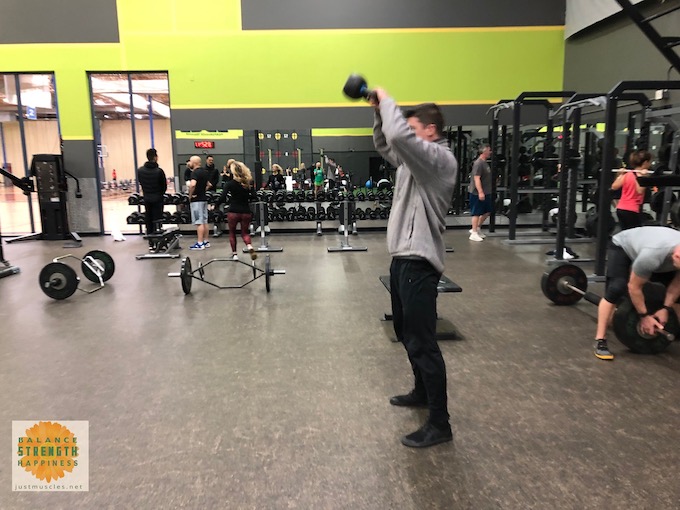
And away!

That makes my stomach hurt! Worse than that, it can wreak havoc on shoulders. There have been studies done with force plates and the physics of the situation can damage shoulder joints badly.
The man who was doing the swing took a rest and came to have some water from the drinking fountain near me. I couldn’t resist, saying, “Albert, did you know that the style of swing you are doing is called an American swing, and the force plate studies say that the kettlebell at that height can wreck your shoulders!”
He reached over and rubbed the A-C joint, which is basically the tip of the shoulder, and said, “Hmn. I didn’t know that, and maybe that’s why my shoulder has been hurting!”
The fix is to keep your swing at the RUSSIAN level- that is, don’t break 90 degrees if someone is watching you from the side.
Here is Zach again demonstrating the proper RUSSIAN swing:
Great start and his hips are hinging and the focus of the load….

That kettlebell comes way back and his forearms are touching the insides of his thighs…

Boom! Snaps his hips forward using both glutes and hamstrings, driving thru the heels, weight on the big toes, with a snake breath to stabilize the core…

And STOPS at ninety degrees.
Beautiful.
Go RUSSIAN with your swings, dear readers, please, for the good of your shoulders and my stomach!
Give me feedback on your preference in the comments below….but you’d better back it up with some research if you’re going to argue for the AMERICAN version!
I am super excited to hear when clients are going away on vacation. Most Americans on average actually don’t take all the vacation time they are allotted, so please go away and take a break!
Your best bet to stay on track with your workouts is to always be aware of your surroundings and take advantage of everything you encounter. Stairs? Take them! Use your hip flexor as you pick your leg up, and then place your heel on the step and drive thru your heel to use your glute and hamstring to complete the step up. That’s an easy example as a way to activate good muscles!
In the video below, I find myself at the airport in the early morning awaiting a long flight. There is nothing I dislike more than sitting for hours on end, so I start scanning my environment. What could I possibly do to move and keep an eye on the gate and hear any announcements that might come over the speaker? Don’t sit down in the waiting area! Grab a chunk of wall and try a gentle Airbench. Split your feet apart and stretch the insides of the thighs. Simply walk the concourses.
Or, as maybe you’ve seen dancers display on social media, use the walking sidewalks to your advantage. What direction do I like to go on a moving sidewalk? Watch the video below to see, and remember the sandals make for a little more concentration. 🙂
Let me know in the comments below what you do to offset the extended sitting and long hours on the plane, train, or automobile!
How to help tight calves and walk on the beach comfortably.
Isn’t the idea of walking barefoot on a tropical beach so fabulous? Add in some gently lapping waves, a couple of palm trees, not a cloud in beautiful blue skies, a few dolphins jumping out of the ocean nearby, and a cool drink in your hand…this is the stuff most people in cold rainy winter climates merely daydream about.
However, some people turn their dreams into reality and head for warmer southern locales as soon as winter strikes! These snow birds sometimes find themselves in a conundrum as they take those lovely barefoot walks on those gorgeous sandy beaches….
Sometimes, but of course not always, these most-of-the-year-shoe-wearing humans have a hard time when their feet slide into flip flops or sandals and then into soft sand.
Who likes to have sand in their shoes? No one, ever.
So what happens to those shoes?
Off they come!
Now you have bare feet navigating soft and hard pack sand, with sticks and rocks and shells as additional obstacles to maneuver around. These bare feet haven’t necessarily had the luxury of walking barefoot or in low support flip flops in quite some time because it is cold up North!
This I thought was the main reason I had lots of clients complaining of REALLY SORE calves and lower leg muscles after returning from a beach-walking vacation.
I think the problem is a trifle more complex than that, and in the video below I offer a potential remedy should you find yourself in a similar situation.
P.S. I NEVER in a MILLION YEARS thought I would be struck down with tight calf-itits….a made up word I created to describe the condition above. Let me know in the comments below if you’ve ever experienced anything like this!
How to Balance out a body that uses one side excessively in work or sport… especially for my tennis and golfers!
Do you play a sport or have a job that uses one side of your body over and over and over?
This cute guy sure does- he is a tennis player and has consistent low back soreness on the side of his body that holds that racquet. He is right handed, and serves right handed, volleys right handed, and even one hand backhands with his right hand.
That right side of the body gets tons of workload as he plays 3-4x/week, and his left side not nearly the volume. The low back and hip on the right side are sore nearly daily, with some occasional neck and elbow stuff thrown in.
What to do in this situation?
Some people might suggest stopping playing tennis, or decreasing the volume of matches. When he plays singles, the games can last 90 minutes or longer. Should I suggest shortening the time he is on the court?
Absolutely not!
I have tried for months to get both sides of his body to balance out and work equally. The other day, I tagged along with him to the gym. I fully gave up trying to get both sides to do the same amount of work and had him ONLY work the left side that wasn’t working nearly as hard or as frequently. The right side has engaged enough, and it was time to fully concentrate on the left side.
By that I mean: Exclusively concentrate on the left side!
(If you are left handed, simply switch the directions to using your right hand.) The following is what we tried with cable weights:
One Arm Lat Pulldown in Squat
Drop down into a squat, and grab both handles for stability. However, ONLY pull down the left side feeling the left latissimus dorsi muscle engage all the way from the mid shoulder blade area to the top of the hip.

Up Chop on the Left Side Only
Break down into a squat, and use the hip to rotate and pivot onto what my golf instructor would call my “ballerina toe” as my arms rise diagonally above my head.
Remember, all good rotational movements are started with hips and oh-by-the-way-you-have arms. Meaning, don’t try to pull that handle up with your arms…let your hips do the rotation and feel it in the left hip flexor and glute.

Kettlebell (or dumbbell if you need to use that) Windmill
Point the right toe sideways, and the left toe is at a 90 degree angle to the right foot.
This exercise is similar to Triangle in yoga, so pop the left hip out and lift your kettlebell up so that you have your arm, wrist, and elbow straight with your fingers pointing to the ceiling. We are really targeting the lat dorsi on the left side again, and look up towards the kettlebell so you know where in space it is at all times. Lean down towards your right toes, and then use your snake breathing (teeth together, tongue against the back of your teeth, exhale hard thru your teeth to make a hissing sound) and swing motion using your glutes to bring your torso back up. Your arm stays in the air at all times! Try for 30 seconds, then 1 minute, then finally 90 seconds as a goal.

Lateral bear crawl
Side view. Move so that you are making the left hip and left glute work exclusively. Push through the left heel as you move to the right.

Lateral bear crawl front view…

Finally, notice when you find yourself shifting your weight on the naturally strong side. This is the way Ian started out his workout, with all of his weight on the right side. This is a big nonverbal clue to me that the left side isn’t working and we need to get it to kick in! If you find yourself favoring one side while you are standing, feel free to shift the weight back onto both feet and let both sides of your body have the opportunity to work equally!

I am happy to report that although the right side soreness wasn’t completely eradicated, he felt significantly better later in the day. I think we are on the right track!
My tennis, racquetball, pickleball, badminton, and squash players of the world as well as my golfers need to concentrate on the other side of the body…maybe exclusively (?) to catch it up and balance it out!
Let me know your strategy to keep you out on the links or on the court in the comments below!
Foam rollers.
For some, these two words bring thoughts.
Of dread. 🙂
Others relish its ability to pinpoint superficial fascial and muscular tightness.
Still others haven’t the foggiest notion on what I’m talking about.
I’m in the middle. I dread it’s usefulness, but I end up gravitating towards it anyway.
I want to make sure my Just Muscles readers know how to use your roller all over your body, because I’m guessing it takes the back burner or you’ve never met it.
In my world everyone knows how to use a roller to massage and beat muscles into submission, but then I meet someone who has never used one and doesn’t know how.
So let’s reset.
Let’s get the basics reestablished, or introduced and established as the case may be.
Get (re)acquainted with your best friend and the $20 fitness tool no home should be without: Mr. Foam Roller!
I love them so much that I really don’t like to go a week without one. I send one ahead to our Airbnb, or to our hostess as a hostess gift if we are staying with friends. I took an old white one with me to Mexico and it was dubbed “oversize luggage” with the skis and golf clubs. Have you walked down the streets of Puerto Vallarta with a roller over your shoulder and very little Spanish?
Talk about funny looks, and only a smile as an explanation. 🙂
Watch the video below to quickly check in with all of your favorite spots, and see if you discover an “ah-ha” moment to help you dig into an area previously neglected.
Let me know in the comments below your thoughts on foam rollers- love? dislike greatly? Dread but useful?
Look forward to hearing from you!
Follow me


Copyright 2022
JustMuscles.net