


How to stretch your adductors aka inside of thigh to help your low back
Does the inside of your knee ever hurt? Does your low back ever ache? Do your legs ever feel tight like you’ve been riding a horse all day?
You, my friend, might be suffering from tight adductors or the insides of the thighs.
They are a big group of five muscles, and are in charge of pulling your leg towards the center of your body as well as stabilize the inside of the hip. Unchecked, they can also grab that femur (thighbone) and rotate it in so that your knee looks like a revolving door with every step.
When I see adductors on fire, I often tease the client I am working with and tell them they essentially are an “eggbeater on land”. That’s how powerful these guys are!
Now, why is that important? Well, if the adductors are in charge, they automatically knock out their antagonist….your friend and mine, the gluteus maximus. The juicy bun-buns!
How does this turn into low back pain? Well, the adductors take over, and then the glutes don’t function, and then if the glutes aren’t working the body says, “we need help from a next-door neighbor muscle above or below the glute max” and VOILA it can tap the low back muscles for assistance. Now the low back muscles are doing their normal low back muscle job, AND the glute max job. Muscles are just like people, and when they have to do their job AND someone else’s, they complain.
The result: LOW BACK PAIN. Inside of the knee pain. Riding a horse all day sort-of tightness.
No bueno. Very fixable.
Try going after those adductors!
Watch the video below and learn where the 5 adductors are, what they look like (take a good look at that monster Adductor Magnus!) and let me know in the comments below what you think! Did it ever occur to you that inside of the thigh tightness could lead to low back soreness?
How to “do cryotherapy”
Once upon a time I was in college and found out that shivering burned 60 calories a minute. I immediately turned to my best friend Janell in class and said, “Let’s open a shiver clinic for lazy people! 60 calories a minute? That means we could pop a person in a freezer for 5 minutes and burn 300 calories!” She just smiled and shook her head as if I was a crazy person.
Here it is 30 years later and someone stole my idea! 🙂 Well, maybe they improved upon it using liquid nitrogen. I recently decided to try out a local tanning salon’s “Fire and Ice” treatment. The “fire” was 20 minutes in a red light therapy bed, and the “ice” was 2 minutes in the cryotherapy booth. There are all sorts of supposed health benefits from using both modalities, including a 400-800 calorie burn in the hours after your session.
If it’s true, then that’s tons better than your average shiver!
Proponents of cryotherapy claim a reduction in inflammation and pain, release of endorphins and energy, faster recovery from workouts, revival of your skin and body thru vasoconstriction, and assistance in things like psoriasis and scarring with the red light therapy.
What did I have to lose? I wanted to see if I felt any better than I did after my cold shower program I have been using for the last year. Was it colder? The booth is supposed to get as low as -200 degrees. Did I feel significantly better with this treatment?
Inquiring minds want to know!

Here is the red light therapy bed. Basically a tanning bed with red lighting bulbs. It was nice to be warm and relaxed for 20 minutes.

Next for the cryotherapy booth! You put on socks, gloves, a robe, and awesome slippers. I also wore a bikini with NO metal on it as metal anywhere can give you a cold burn…the opposite of a sunburn. You want to be perfectly dry and wait at least an hour after your workout.

Here is the booth! They put risers in to make it fit your particular height and your head sticks out the entire time. The attendant stays with you for the 2-3 minute session.
Now for the burning question of the day: How did I feel immediately after and 24 hours later? Immediately after I felt great and did 45 minutes of yoga. 24 hours later I felt great. Did I feel crazy better? No. I was hoping for a gigantic difference. However, I generally feel great after a workout and my cold shower, and I think my cold shower is colder in some respects!
The cost ranges from $35 to an intro session to $70 for additional sessions. You can join for a weekly or monthly membership fee. Would I do it again? You bet. However, the convenience of turning on the cold water in the shower for 1-2 minutes is tons easier than an ice bath and tons more convenient than making an appointment and traveling for another Fire and Ice session, and I think accomplished the same thing for recovery. I don’t know where the stats about the big calorie burn are derived- if that’s true then it is a very efficient “workout” time!
Here is a video showing the session in action and the attendant extolling the virtues at the end. Watching the nitrogen gas roll out of the booth as the door opens is pretty cool! 🙂
Have you tried a cryotherapy booth? How did you like it? Let me know in the comments below!
Feeling low energy or a bit of a scratchy throat after the holidays? There are three big things you can do to help this!
1. Stop with the sugar, in all forms. The carbs, the alcohol, and even the crackers. Please eat your veggies! Our favorite nutritionist Margaret Floyd Barry found recent research showing that it takes 14 days for your gut to fully heal from a sugar blast.
2. Your immune system is a one way system pumped up by the alternate contraction and relaxation of muscles. So, get your muscles to contract and relax! MOVE!
3. I have a recipe for fighting off flu and cold symptoms that I have shared with many clients. Please check with your doctor before using this or any other concoction, which is what I call this stuff.
First ingredient: a glass of Aloe Vera Juice (this particular one I find on the bottom shelf of the drink aisle in Trader Joe’s in the gallon jug)

Once upon a time I was getting ready to fly a red eye to NYC to run the New York marathon, I wasn’t feeling very good, and told my Thursday morning client that I was concerned. She said, “You need to drink aloe! It is a very powerful anti-viral!” She proceeded to hand me a 32 once bottle of it, which I dutifully drank while we were working out. I handed her back the empty bottle, and she said, “You finished? Take another one and drink it on the way to the airport!” So, by the time I had climbed on the airplane I had a good 64 ounces of aloe vera juice sloshing around in my belly. However, I woke up in New York Friday morning after flying all night and felt great! I became a believer, and if nothing else you are super hydrated.
Second ingredient: Grapefruit Seed Extract Drops ( which if you are on high blood pressure medication grapefruit might interfere so check with your doctor!)
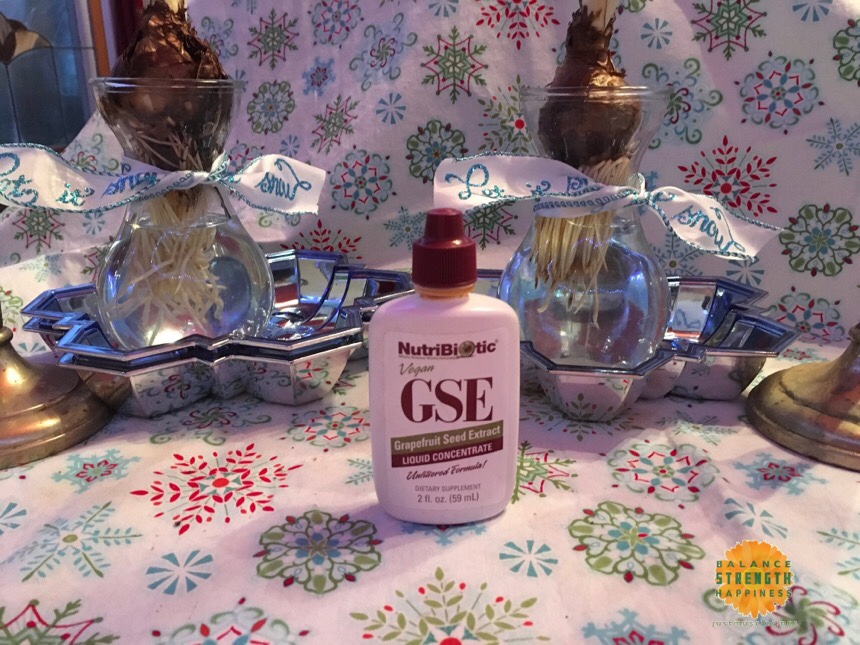
Once upon a time I was getting ready to go to Mexico on a yoga retreat with our favorite nutritionist Margaret Floyd Barry and our leader Deb Joy suggested we bring Grapefruit Seed Extract Drops and put 12 drops in your water bottle to prevent “travelers tummy” aka diarrhea. On the label it explains what an awesome anti-bacterial it is …but it is very sour and can burn so never put directly on your tongue and please shake or stir well! You can use it in the laundry, too.
Final ingredient: Emergen’c or some other powdered vitamin C.
This one is inspired by my dad and Linus Pauling, plus it makes the drink taste just a tiny bit better, assuming you can tolerate fizzy things. If you don’t like fizzy stuff, then wait for it to go flat.

STIR WELL! Down the hatch! 🙂
Let me know in the comments below what you like to do when you’re not feeling well.
Percussion Therapy Gun: a last minute gift idea
Check out the latest in percussion therapy – the Opove G3 Pro Massage Gun.
There are lots of these devices out there- made by Hyperice ( think of the compact green vibrating sphere that I reviewed in an earlier blog https://justmuscles.net/foam-roller/accelerate-foam-rolling/) and Theragun for instance- and some are significantly more expensive than others, but this got great reviews on Amazon even though it’s not so highly priced.
The history of this device is actually based on a jigsaw- and the manufacturer placed a round ball on the end rather than a saw blade. The effect is the same, but those manufacturers did little to dampen the noise of the jigsaw, and it was difficult to have a normal conversation.
Not so with the improved later versions…the noise is significantly dampened. When the ball hits a tight spot (or bone- be careful!), it starts “thumping” to break up the tightness. You might not know there is a tight spot there, but the “gun” will let you know. Additionally, the handle is extra long which allows you to spin it onto your back comfortably while still hanging on.
If you need muscle relief fast, here is one in-home solution for you! It comes in a handy little case with four attachments to hit various body parts.
See it in action below, and if you need a last minute gift idea, it’s not inexpensive but it will be in the house for the whole family to enjoy…including you! 🙂
What’s the fastest way to get into shape?
Meet Pete.
Pete is an old friend of mine, and loves to play soccer. He wanted to get back into shape, and research shows that intervals for your cardio is the most efficient way.
What was the fastest way to get him back into shape?
Try what the great Martin Rooney of trainingforwarriors.com calls a “hurricane”.
He points out that a hurricane is a short, powerful storm that interrupts everything. This is how we would like you to do your cardio- something short and powerful that gives your metabolism a big interruption in a good way.
The structure is simple:
Get your heart rate up as high as you can for 30 seconds, wait for the heart rate to return to 120, and repeat nine times.
Please check with your doctor before embarking on this or any exercise program, but those are the general guidelines.
So this is what I did with Pete the first time we met, and he chose to dribble a soccer ball for the 30 seconds. Great! The more fun the better!
He sprinted down the field, and when he hit 30 seconds I started my clock to check his recovery time. He happens to use an Apple Watch to check his heartrate, so we kept checking it. (You’ll want something to be able to check your heart rate.)
We checked it again. Not down yet.

And kept checking it.
And checking it.

And checking it.

And checking it.
Still not down.
Now mind you, I had done a hurricane workout with another client Kristin earlier that day, and her recovery time was about 30 seconds- 1 minute at most inbetween intervals. With Pete we were now pushing 15 minutes to recover from the first interval. She had recently run a half marathon, and he was at the very beginning!
I had him close his mouth and only nose breathe to attempt to get his heart rate back down.

Finally, he hit as close to 120 as I thought we were going to get- around 123. He started his second interval after 20 minutes of recovery.
This was mid-July, and he didn’t workout outside of our once-a-week workouts, but look at the improvement he has shown already! We are able to get almost the whole 9 intervals accomplished now, and we have added 30 seconds of core work at the end of the interval. Fantastic work considering he just got started 4 months ago!

Super proud of Pete, and all my clients out there busting out hurricanes!
Look at Pete after a workout, all happy and tired out. This is my recommendation: the most efficient way to get your cardio in…hurricane intervals!
Let me know if you need some help getting started or what your favorite interval program involves in the comments below.

How to help a knee with Shasta the doggie!
Meet Shasta.

She’s an 8 year old full blood rescue Akita. Sweet and happy, and likes to play with her best friend Sasquatch. One day while playing with my lab Nova at the park, I noticed her owner carrying her along the sidewalk. I jokingly said, “Does she not want to leave the park and you have to carry her home?” Her owner replied, “No, her back leg collapsed and she can’t walk. I have a bad feeling she just blew her other ACL.”
What?? I felt horrible. Poor sweet Shasta.
Weeks later, she magically re-appeared at the park with some new scars but seemed as good as new. Indeed she had blown her ACL- anterior cruciate ligament in her knee- and had it repaired.
However, when I watched her walk, I was concerned. Here’s what she looked like from the back (sort of) holding still.

See how her feet point outwards? This happens in humans too, for instance with my client Michelle:

Michele has no cartilage left in her right knee and although it isn’t painful we have been working on it to stabilize it. You can see the knee angle in (called a valgus stress on the knee) just like Shasta, and her feet turn out a bit also. Humans and doggies face similar challenges when it comes to joints, and when my Akita Nutmeg had a hip problem years ago the vet told me we could take baby aspirin every day, replace the hip, or do nothing. That’s basically what my humans are told, too!
Watch Shasta walk in the video below and then I tacked on a film of Nova walking. What major muscle seems to be missing with Shasta? (Hint: on the back of her legs)
Her hamstrings!
When I pointed out this big deficit to her owner, he said, “Well, what do I do for her? I can’t make her do exercises like you do with humans!”
Good point.
I had a similar experience with my Nutmeg- although in her case it was her hips rather than her knees that were bugging her. Her feet started turning out and her hamstrings basically disappeared. By the way- this happens with humans all the time too!
What is the solution?
I walked Nutmeg up long, steep hills very slowly. That promotes leg and hip extension and helps the hamstrings engage in both doggies and humans. I have clients try and use hills to take pressure off low backs, knees, and calves.
Walk up a steep hill and see what happens!
Let me know in the comments below, and take a good look at your doggie, too!
How to fix nerve pain in your leg
Can you lie flat on your back? Have you ever had nerve pain in your low back, hip, front of the leg, back of the leg, or foot?
I have had two clients this week alone with symptoms in both areas. My client Leslie suddenly developed what she described as ice running down the front of one leg, and my client Mark has had persistent nerve pain in his right low back/hip area.
My right leg feels the sciatic nerve fire up when I am stuck driving for too long. Does this ever happen to you?

It’s a thing!
And it super sucks. 🙁
However, I have a strategy for you to employ. It is a bit time consuming, but if you have the goal of lying comfortably flat on your back, this is the way to help you get there.

You might want to take a peek even if you aren’t currently suffering form any maladies as I cover the anatomy involved and try to explain those ever-elusive hip flexors and the role they play.
Once you’ve watched the video, I am super interested in hearing what you think. What techniques have worked for you? Let me know in the comments below!
This video is around 8 minutes
How to release neck or shoulder tightness in the car

Have you ever been in traffic, on a long road trip, riding in a train or bus and experienced neck or upper back tightness or pain? That unfortunately is not an unusual occurrence and recently happened to me. We have been painting our newly rebuilt porch and the 10am to sunset work for multiple weekends in a row was starting to rear it’s ugly head.
So, I started to experiment.
What could I do, essentially stuck sitting in traffic?
Well, I have an exercise I like to use standing up, with my palm flat on the wall. You anchor the palm to the wall and relax your shoulder, and rotate your elbow. I call this exercise Chest Openers.
The goal is to get your shoulder blade to rotate as that is one of it’s three main directions to move….in and out, up and down, and rotate.
The rotational component of shoulder blades is one of the trickier directions to identify, but if something pinches as you lift your arm or when you reach overhead, chances are your shoulder blade’s ability to rotate is compromised. Also, if you have any sort of elbow problem like golfer’s elbow or tennis elbow, all that says to me is that your elbow is being forced to do what the shoulder blade should already be doing.
Don’t worry, it’s very fixable!
The trouble is, the upper trapezius muscle feels like it needs to help and that’s where the tightness and pain can originate. So, in the video below, you’ll see me compress the upper trapezius muscle to disengage it as I try to re-engage the lower trazpezius muscle.
My favorite combination: a little release, and a little engage.
Get that upper trap out of the way and let the lower trap join the party!
Watch the video below and let me know in the comments below if it helped! I love hearing feedback on what works and what doesn’t!
Don’t let your shoulder pick your leg up!
Have you ever laid longways on the roller to release upper back, shoulder, or neck tightness only to find that you it isn’t working as well as it usually does?
Hmn. What is going on? Has the roller reached the end of it’s useful life?
No, that’s not it.
Well, I have noticed lately that when shoulders get tight, one potential cause might be that they feel like they need to help with every other muscle.
Specifically, when you are trying to lift your leg up off the roller to activate other hip muscles.
I have watched shoulders time and time again go from a twitch to a full lockdown in order to assist the leg being picked up.
That shoulder just pops forward and tightens up!
It doesn’t seem to matter what muscle in your lower body you are attempting to activate- all of them should be able to work independently of the upper body.
You should be able to let that upper body relax, but if you need it to anchor, use the lower parts of the shoulder blade itself.
I explain more in the video below:
Let me know in the comments below if you now notice your shoulders trying to help and what you did to remedy the situation….and more importantly if it helps release the upper body tightness!
How to Balance on a Ball
Ever wanted to run away and join the circus? I did after my first attendance at a Cirque du Soleil performance. What incredible feats of balance and strength and flexibility!
Balance is something that I like to work on with all of my clients, as it gives you immediate feedback (not balanced? You fall over! 🙂 and you can do it in fun ways. I generally save it for the end of the workout when you’re more fatigued; that way you really have to think about how you are going to execute.
You can see synapses firing! Steam coming out of ears! It is fantastic.
Here is one way to practice your balance, and simultaneously your first Cirque move.
Let’s grab a big Swiss ball, and climb onto it with our knees. Sounds easy enough, right? (You might want to be close to a wall or a chair in case you want to throw an arm out for balance.)
Anchor your knees
My first tip in attempting to balance on a ball on your knees, is to anchor your knees into the ball, and push off the ground with your toes. My client Elizabeth demonstrated it beautifully here:


I say that every time with a demonstration, and every time, everyone lifts their foot off the ground and tries to put their knee on the top of the ball, like my client Sara did below for demo purposes.


Every time. Cracks me up. 🙂
See how Sara has less shin in contact with the ball? That is less surface area to give you stability. She is balancing, but just barely.
Additionally, guess what generally happens when you lift one foot off the ground? You start to fall over.
How to balance on a ball
Let’s start again! Dig both of your knees and shins into the ball, and push off the ground with your tippy toes. Your hands will also be planted on the ball, and you can gently push away and down on the ball as the ball rolls slowly forward.
Remember your hips are your center of balance, of gravity, and of buoyancy; interestingly enough they will make or break how you move on the ball.
Find your hips and you will find your balance!
Now as you create the stability, slowly lift your hands up off the ball. Be prepared to have things be slightly squirrelly for a bit.
Feeling advanced? Play catch with a ball and a friend (or a throw it against a wall!) while you are kneeling on the ball. What?!
My client Gary is demonstrating catching a ball while balancing below. Not only is it possible and useful, it is fun!

Let me know in the comments below how much fun you had attempting to balance on your knees on a ball, and what you think your chances are at the next Cirque tryout! 🙂
Follow me


Copyright 2022
JustMuscles.net