

Wondering if you should add to your home gym with a new fitness machine? I tripped over the DBMethod machine recently and was super excited to see someone else focusing on glutes!

They promise an amazing strong perky booty, supposedly endorsed by the Kardashians. We know this doesn’t necessarily mean anything, so I delved further into the website to see what their trick was.
They have a YouTube channel where they posted their beginning and advanced workouts. The beginning workout was 5 minutes long, and the advanced workout was 10 minutes long.
Guess what they did for the entire time, nonstop?
Squats!
Nonstop squats. 5 or 10 minutes in duration.
The machine forces the user to primarily sit, hang onto handles, and lift their toes up. They also cue you to lift your toes in your shoes. These are all great things! These generally are things I tell my clients to do, too.
However, why do you need to have a machine to do nonstop squats for 5 or 10 minutes?
I decided to challenge my clients this week to 5 minutes straight of squats. The video below is of my client Kristen, who encountered a few issues in those 5 minutes.
Tight knees and quads. Tight low back. What if that happened to you? What would you do?
Watch the video below to hear my coaching around these issues, and we are going to check back in with Kristen next week to see what strategies worked and what didn’t.
Would I recommend you put this on your list?
Nah.
You can do it on your own!
Stay tuned….
How to keep calves out of a shoulder bridge
Ever tried to do a shoulder bridge? They are relatively easy: You are on your back, knees bent, and you are lifting your hips in the air. However, if you don’t pay attention, you can just use your quads to do the lifting. When you work with me you know that you should be driving through the heels to get your glutes and hamstrings to work.
What if you are having difficulty (we don’t say CAN’T) getting your glutes and hamstrings to work?
What if you can only primarily feel your calves?
This was driving me bananas the other day, and I had several clients try beating their quads into submission to get the hamstrings to engage like this:

In this case, notice that the right foot is particularly cattywampus, which is easy for me to see, but hard for my sweet client Kristin to see or particularly feel. It feels normal. Worse than that, I wasn’t convinced her calves were staying out of the exercise that was primarily targeting her hamstrings.
So we flipped her like a pancake on over to her back like this:

Now she could press her calves into the roller, press out against the stretchy band, and lift her hips up to focus on those glutes and hammys. Once she and I were both satisfied we had our target muscles working, we upped the difficulty by putting the soles of the feet on the roller like this:

So, we created the neural pathway and made the conditions tough for compensation to take place…and then once the right muscles were working, we added in a bigger movement to really get those hammies strong.
Give this exercise progression a whirl (and don’t even worry about the stretchy band) and let me know how much your hamstrings in particular love you afterword in the comments below or on social media. We need the world to know there are solutions! 🙂
Adductors are the insides of the thighs, and they are driving me crazy! They are tight on a whole slew of clients, so here’s the scoop on where they are and what they do.

In this case, my 14 year old client Emilia was complaining of knee pain. When I had her try a single leg squat above, it was pretty obvious why her knee hurt.
Look at her foot position versus her knee position. Foot straight ahead, knee rolled in. Ouch!
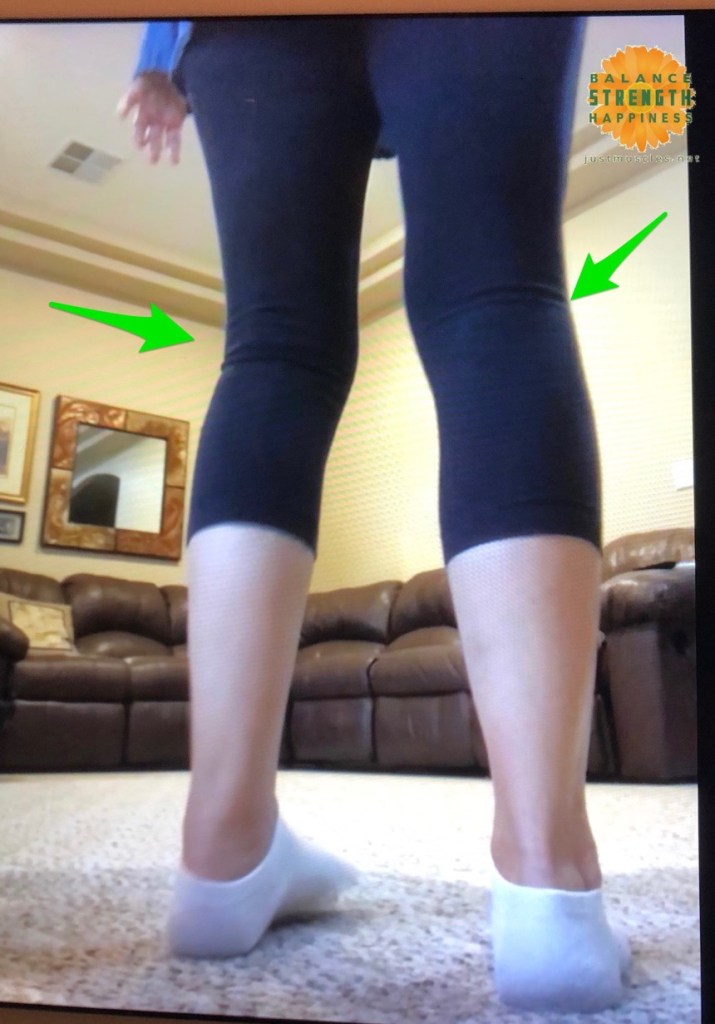
Here’s another example with my client Shannon above. If you again compare her foot position with the knee position, you can see the pull inwards that the muscles on the insides of the thighs- the adductors- are creating. Sometimes they cause a twist, and sometimes a pull. In this case, they are pulling that thigh bone in.

Adductor tightness even shows up in babies. This is sweet baby spider Zion (he showed us his crawling pattern in an earlier blog) and you can see how powerful the insides of the thighs are by the way his legs relax. He’s in pediatric physical therapy to correct the way his feet hit the ground.
Below is a video explaining the anatomy so you can see exactly where the muscles are (and keep an eye out for the adductor magnus- it’s a monster and you’d never know it was hiding under these other muscles!)
The big question: What can you do?
What can you do if you see yourself in any of these photos? Easy enough! At the end is an exercise that will jog your memory on how to get these powerhouses back under control and give their antagonist – our friend the glute – a chance to balance them out! Let me know how it goes in the comments below.
I had the good fortune to have a conversation with what’s termed a “long haul” COVID 19 survivor…my client Anna.

“It feels like my heart is going to wear out. It can’t possibly beat like this and live a long life,” she told me in our hour-long interview.
Anna prior to contracting COVID was a half marathoner and in tip-top shape. She lives in Southern California and said, “10,000 steps a day was no big deal to me back then.” Months after contracting COVID she couldn’t walk for more than 10 minutes around her house.
Walk. Just walk.
Mind blowing.
Come listen to this compelling and fascinating story from a woman who braved the virus from the get-go. She experienced a myriad of symptoms (that did not strike her family) and systematically searched for someone or something to help her feel better. She often wondered, “Is this my life now?”
I could have talked to her for hours. Tune in, and if you know someone struggling, the resources she has devoted the last 6 months curating will be located at the bottom of this blog.
Her spirit and quest to be well is amazing and heartbreaking all at the same time.
“I wouldn’t wish this on my worst enemy,” she told me.
If you would like to learn more, here are some handy links for more information provided to me by Anna.
https://apple.news/AbniFJrWLQuKqSzPHyOCbiw
https://www.wearebodypolitic.com/covid19
COVID BOOTCAMP
Are you suffering from too many Zoom-meeting-itis? Is your body complaining mightily from the quantity of sitting in front of a screen?
Ugh.
I totally hear you!
So, here’s what I have noticed….
If you are on a virtual meeting and sitting in a chair, your fellow meeting attendees can see mostly your head and shoulders.
Ever tried sliding onto your knees to open up the front of your hips, give your back a rest, and gently stretch the fronts of your quads?

Grab a pillow or a yoga mat to give your knees some cushion, and *poof* slide out of your chair onto the floor.
No one on the meeting will be the wiser as they can still see your head and shoulders!
Next, if you are sitting, try pushing your heel into the ground one at a time until your leg is extended, and then dig your heel in and draaaaaagggg it back.
This will activate the hamstrings!

If you are unclear about how to do either, watch the video below for a quick demonstration. Let me know in the comments below how you like kneeling through meetings! (I’ll bet you like it more than you might think 🙂
America will greatly miss Ruth Bader Ginsburg and my favorite quote about her is, “She attributes her long career to her fitness routine.”
Take that into serious consideration.
Not her education, not her family, not her colleagues: instead, her fitness routine.
If ever you needed a role model, look no further than the woman who battled cancer for 20 years and lived to be 87! Thank you, RBG, for your 27 amazing years as the Supreme Court’s oldest justice.
Let’s take a look at what an 87 year old does exactly with her trainer and celebrate such an amazing lady. The video of her demonstrating the exercises is below, and I have made a video of me demonstrating her exercises too.
Follow along with 5 of her favorite exercises and you too, can be strong like Notorious RBG.

You might be surprised to see her throw the medicine ball around, and my favorite move is her single leg squat. She busts those out with tons of balance and speed!

I watched many videos of her working out, and I loved everything she did. My only concern was the very forward position of her head. Please be careful to spend some time away from your work so that your neck isn’t subjected to “text neck” or a host of other symptoms that can manifest with too much time in front of a computer or sitting for work.

Lie longways on the roller, lie flat on your back with your legs up at 90 degrees…anything to get your head back in line with the rest of your body.
RBG, America misses you greatly for all of your crowning achievements and incredible contributions…rest in peace, awesome lady.
As for the rest of you: get out there and MOVE!
Lest I sound redundant: She attributes her long career to her fitness routine.
Start right now.
With all of the world out on walks and hikes and runs like never before, I have seen unprecedented tightness in the inner thigh or adductor muscles. Wanna get after them?
First, start rolling the insides of the thighs with your roller.
That looks like this, in case you’ve not tried it:

That might be enough. That might feel really tight, or like my client Tiffani said the other day:
“Holy adductors!!!! I had no idea they were so sore!!!
I’ll see how I feel tomorrow!!!??”
Remember you always have the option of rolling, and if that goes well, then please feel free to scrub or cross fiber roll the muscle.
If that goes well, then I suggest you try setting up the roller with the following modification:

Saw a tennis ball in half, grab your handy dandy duct tape, and secure the half tennis ball to your roller.

Now start the adductor rolling process again, and ~voila~ the magic happens! You will be able to target and tap into inside of the thigh tightness like never before.
It looks like a relatively insignificant modification, but trust me, it will dig into those 5 powerful muscles in a way that a smooth surface can’t access.
This is a fast and easy way to get those muscles, one of the primary antagonists of the glutes, out of your way.
If you see your knees knocking or rolling in, you’ve got tight adductors. If you ride a horse on a regular basis, and grip onto that horse to hold on, you’ve got tight adductors. If you walk or run, swim, or bike…you’ve likely got tight adductors.
Give rolling the inside of the thighs a whirl, or really dig in with the half tennis ball, and let me know how it goes in the comments below.
Look forward to hearing from you! Stay safe, and look for silver linings and blessings 🙂
Recently we traveled to Glacier National Park, and decided to go hike the Hidden Lake trail. Wouldn’t you know, the trail was actually built out with boards that made a series of steps and platforms for relatively (this is at 6000’ + feet!) easy travel.
Planks, if you will.
As we were hiking along, I thought, I need to do a plank on a plank!
Have you ever entered a progressive plank challenge, where you start with a ten second plank and add five or ten seconds every day for thirty days? By the time you are done, you’ve reached 300 seconds or 5 minute plank.
Does that sound like fun?
Do you think your form will improve or dissolve the longer you stay?
Well, good on you if you choose to spend your time that way. However, I propose another viable solution.
Just as much can be accomplished in a mere 10 seconds.

In fact, I would argue more can be accomplished!
The trick is to maximally contract almost every muscle in your body for those 10 seconds…Every single muscle that you can get to contract.
Obvious ones are the core itself, then all the quads on the fronts of the thighs, then your glutes, then push up towards your hips from the toes, and pull down with your hands toward your hips into the ground so you’ll get your lats involved… and don’t forget to breathe behind the shield.
Breathe behind the shield? What?
Picture a set of amazing 6 pack abs. If those abs are contracted, then it is hard to breathe diaphragmatically.
Hard….but not impossible, and I throw out this challenge to you.
Lock down that core in your ten second plank, picture those 6 pack abs, and breathe in and out through your nose into your diaphragm without losing the lock!
Can you do it?
Of course you can, you just need to try!
Here is a quick (windy! A little noisy!~) video of planking on a plank.
Caveat: I was in a rush inbetween up and down fellow hikers, and it was cold at altitude at sunrise so I have a skort on underneath my mini dress (I forgot pajamas and we left our campground at 5:20am to get into the park to secure a parking spot). Forgive the outfit 🙂
Let me know in the comments below how breathing behind the shield goes, and shortening up your plank to a powerful 10 seconds!
When muscles get out of balance is when trouble starts!
Every muscle has a role, and the balance of the system is integral to the health and happiness of the human. So when muscles get too tight in one spot, and won’t let go easily, is there a way to get them to cooperate faster?
This has been a recurring problem for clients this week, and I have an idea for you…
Do you happen to own some sort of massage tool? I’ll bet you do as lots of things will work in a pinch. Consider a dryer ball, a smooth rock, a spatula, spoon…or something fancy like the Opove G3 Pro massage tool or fascia blaster.
You want something to dig into the muscle, and here’s the trick:
Put that muscle on a stretch before you dig in!
What do I mean by that?
For instance: the outside of your hip is tight. Try crossing your foot on your knee, bringing out the tightness. Now turn on your Opove, or grab your fascia blaster, or scoop up your spoon …and dig into the tight spot as you let it stretch for our favorite ninety seconds.

Not only will you get the stretch, but also break up any surface fascia adhesions or restrictions those fibers have imposed.
It’s a win-win!
Here’s a quick video demonstration on how easy it is to combine two great muscle concepts: stretch and massage, simultaneously!
Let me know in the comments below how you like the combo. Looking forward to hearing from you.
Here are easy links to purchase these two items.
Part of one of my wishes for the world is that babies have a safe and loving environment in which to grow and thrive. I recently tripped over a video of a niece’s 13 month old baby crawling… or doing his darn best.
It wasn’t going so well. Really cute, and he’s so sweet, but….
Here’s the thing: I’ve seen this before, and it is relatively easy to remedy this situation. We don’t want to skip this step in the foundational primal movements. Crawling puts hip flexors into your body’s available muscles to move with, and if you skip it, we have to pattern it in as adults!
Watch his sweet little self below do his best, and then see what I am having his mom try with him to fix it. I’ve seen it resolve (meaning army crawl to ‘normal’ crawling) in as few as four days! I hope to have a follow up video so we can watch his progress, too.
Funnily enough, the star demonstrator of the show, Miss Sasha Barry, was having identical crawling problems about 2.5 years ago. The recommendations for her little body included orthotics and physical therapy. Turned out with such narrow hips, her parents had unwittingly turned her into a little bow legged cowgirl by carrying her around (like all parents do!) on their hip. All parents want and need to have one hand free, but in this case, it was messing with the balance of muscles in her hips.
I am also concerned when I see small people carried around in carriers like the one I snapped a photo of below:

Same issue- the kiddo’s legs are split really far apart, and although it is handy for the parents, I am concerned about the constant big stretch those femurs are subjected to. That’s a little cowgirl in the making, just like Sasha.
The trick is to have fun and sing a song while you are moving the femurs in the two main directions hip flexors are responsible for…up and down, and rotation. I chose “Wheels on the Bus” to sing with Sasha as we were doing her “exercises”. It takes 5 minutes and it will make a world of difference in how the baby or toddler moves.
Let me know in the comments below if you have other successful interventions for the unusual crawling you have seen in your family!
Same issue- the kiddo’s legs are split really far apart, and although it is handy for the parents, I am concerned about the constant big stretch those femurs are subjected to. That’s a little cowgirl in the making, just like Sasha.
The trick is to have fun and sing a song while you are moving the femurs in the two main directions hip flexors are responsible for…up and down, and rotation. I chose “Wheels on the Bus” to sing with Sasha as we were doing her “exercises”. It takes 5 minutes and it will make a world of difference in how the baby or toddler moves.
Let me know in the comments below if you have other successful interventions for the unusual crawling you have seen in your family!
Follow me


Copyright 2022
JustMuscles.net